Will China's real estate bubble burst?
|
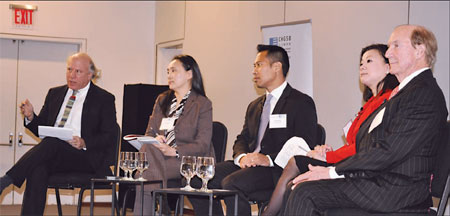
Moderator Adi Ignatius (left), editor-in-chief of the Harvard Business Review, makes a pointduring a panel discussion on the investment climate in the US and China at the 10th China Institute Executive Summit Agenda in New York. Next to Ignatius and from left, theother panelists were:Zhang Lanlan, president and CEO of China International Capital Corp USA; Harvey Fine, managing director for global investments and strategies, Fosun Group; Wendy Cai-Lee, senior managing director, head of US Eastern Region, for East West Bank; and John Allen, chairman and CEO of Greater China Corp. Michael Barris / China Daily |
Experts argue over long-term effects of rise in interest rates.
An inevitable rise in interest rates will lead to a real-estate crash in both China and the United States within a decade, a conference on US-China business relations was told.
"When people buy or rent real estate, the one thing they look at is, 'How much do I have to pay per month to own it or to rent it?'" said John Allen, the chairman and CEO of Greater China Corp, at a panel discussion about the investment climate in China and the US that was part of the day-long China Institute Executive Summit in Manhattan. "If interest rates rise just a little bit, the principal value of those properties drops a substantial amount."
"Not this year, not next year, but certainly within the 10-year period, we're going to see another real estate bubble burst, both in China and the US," the former head of Bank of Boston's international investment unit said on Friday. Greater China Corp is a diversified company involved in real estate, financial services, media and technology.
The US Federal Reserve's plan to wind down its monetary stimulus has sparked speculation that short-term interest rates could rise from a record low. On Friday, a better-than-forecast US October jobs report indicated the unemployment rate ticked up to 7.3 percent - well above 6.5 percent, the level at which the Fed has indicated it would start increasing interest rates. The Fed's monthly buying of Treasury and mortgage-backed securities, known as quantitative easing, keeps longer-term rates - such as mortgages - lower than they would be otherwise. Those low rates allow businesses and homeowners to refinance their debt at lower rates.
Low interest rates and cheap credit fueled a surge in property prices in China starting in 2000. Real estate accounts for about one-fifth of Chinese investment. A combination of high prices and overbuilding in China have raised concerns that the nation has a real estate "bubble" that is about to burst.
Allen said that "if we around the world begin to eliminate quantitative easing, and interest rates and particularly long term mortgage rates begin to rise from 3.5 to 4.5 to 5 percent to 10 percent, and even higher, which is where it's been historically, the prices of the real estate to either lease or acquire is going to drop precipitously."
Several analysts told China Daily in July that a crash in China's real-estate market was unlikely, due to the growing nation's resilience to the market's gyrations.
Youguo Liang, a former managing director of Prudential Real Estate Investors, a unit of New Jersey-based Prudential Financial Inc, said that as long as China remained in a "growth cycle", it could absorb the expansion in its real estate market.
China's per capita GDP is still "very low" - not only for a developing country, but even for a developed country, Liang said. "There's still tremendous room to grow." Moreover, he said, the country's infrastructure investments in recent years and its centralized system of government gave it the power to use policy to effectively manage real estate market swings.
A slowdown in Chinese real estate would adversely affect countries that sell to China's property and construction industry, as well as those that export to countries exposed to the China housing market.
Meanwhile, Chinese investors continue to pour money into US commercial real estate deals despite China's recent economic slowdown.
Last month, Shanghai-based Fosun International - the investment firm headed by billionaire Guo Guangchang - agreed to pay $725 million for One Chase Manhattan Plaza, a high-profile 60-story office tower in New York's financial district. In June, a group led by real-estate tycoon Zhang Xin acquired a 40 percent stake in the most expensive US building - the General Motors office tower in midtown Manhattan. Big commercial real-estate deals also have been made by Chinese investors in San Francisco, Los Angeles and other US cities.
The panel included Zhang Lanlan, president and CEO of China International Capital Corp USA.
michaelbarris@chinadailyusa.com