Lines crossed over graft in state firms
Anti-corruption drive provides some valuable lessons and throws up a few questions
Rarely have so many high-ranking economic officials in China made the headlines in such a short time - and all for the wrong reasons.
First, on Aug 26, the Ministry of Supervision announced that Wang Yongchun, former deputy general manager of PetroChina's parent company, CNPC, and boss of Daqing Oilfield, the largest oilfield in the country, was being investigated for "serious disciplinary violations".
The following day, three other CNPC senior executives were named as investigation targets.
On Sept 1, the Ministry of Supervision said on its website that Jiang Jiemin, former chairman of the State Assets Supervision Administration Commission, a ministerial-level government body, was being investigated for what insiders said was an "astonishing amount" of embezzlement.
The next day, Tian Xueren, former vice-governor of Jilin province and chairman of Jilin Bank, was charged with accepting bribes 85 times, their value totaling more than 19 million yuan ($3.1 million, 2.4 million euros).
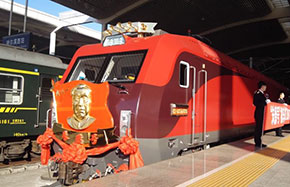
A day later, Zhang Shuguang, a former senior official of the former Railways Ministry, was charged with accepting bribes 13 times, their value totaling more than 47 million yuan. Zhang was one of the collaborators of Liu Zhijun, the former railways minister convicted in July of having taken more than 64 million yuan in bribes and sentenced to death with a two-year suspension.
Also on Sept 3, another former official of the Railways Ministry, Su Shunhu, faced a Beijing court accused of economic crimes.
Rounding up so many officials, once political rising stars in industry and large state-owned enterprises, and accusing them of corruption creates a good opportunity for the country's leadership of President Xi Jinping and Premier Li Keqiang to build public trust.
These cases also point to how many holes have existed in the management and supervision of large SOEs. The most gaping hole to appear is the one in the theory that society can be turned into a huge factory, part of that belief being that it is up to the state to provide funds and to cover all risks and losses.
Ronald Coase, a British economist based in the US who won the Nobel Prize in economics in 1991, and who died on Sept 2 aged 102, reckoned the theory was a fallacy.
On his passing, many Chinese business websites paid warm tribute to him, even though he had never been to China. For many economists he was a mentor, and without his influence the management of SOEs would have had many more holes.
Of course, China has not turned into a large factory. The reform of the past 30 years has created millions of companies that compete with one another domestically and globally. But many SOEs still bear the key hallmark of their legacy: receiving government funds but lacking administrative discipline in their daily activities.
That gives SOE executives ready access to easy money and unregulated power. In the end it is like handing a whisky bottle and a set of car keys to a teenager.
Corruption in the senior ranks of SOEs highlights the need for redrawing some lines that reform has so far not drawn clearly enough.
There is no dispute that SOEs are useful to guarantee society, especially such a large one like China, its strategic supplies. But should they directly be involved in competitive business? Should they be expected to chase ever-increasing profits in the market place, or to maintain stable operations the way utilities companies are required to do?
Should there be a wider separation between a parent company that takes care of a stable core business and any competitive entity under its auspices? Should SOE executives, and not just board members, be appointed by the government?
With the current anti-corruption drive, such questions need to be answered, and when they are, it will provide invaluable help in continuing to reform SOEs.
The author is editor-at-large of China Daily.