Still strong in textiles through innovation
|
Worker inspects spinning quality at a Central Textiles subsidiary in Zhanjiang, Guangdong province. |
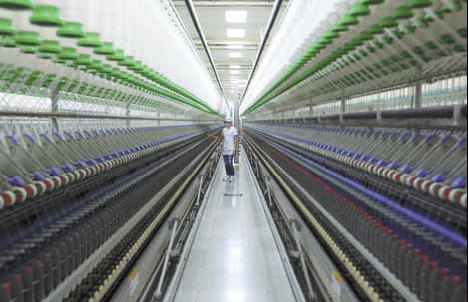
Despite rising costs and fierce competition from Southeast Asia, a Hong Kong-invested textile company in Zhanjiang is still confident about business growth due to its persistent pursuit of technical innovation and strong support from the local government.
Chung Charm Textiles Ltd, a subsidiary of Central Textiles (Hong Kong) Ltd, is celebrating its 20th anniversary this year in the coastal city in South China's Guangdong province.
"We are happy with our relationship with Zhanjiang government. We have received vigorous backing," said Woo Pat-nie, director of Central Textiles.
"For example, thanks to the power supply bureau, our factories have run into far less outages than other textile factories in the Pearl River Delta, avoiding possible losses of 1 million yuan ($163,000) a day."
Woo added that the two factories at Chung Charm Textiles in Zhanjiang enjoy low staff turnover because most are long-term locals.
With direct air service between Hong Kong and Zhanjiang resuming on Aug 2 offering four flights a week, it's more convenient for Woo's company to transport the yarn from its Zhanjiang factories to its fabric facility in Hong Kong.
Zhanjiang's ice-free, deep-sea port also facilitates freight transport.
About 70 percent of the cloth produced by Central Textiles is for export, mainly to the United States and Japan. The company's clients include Levi's, GAP, Timberland, Marks&Spencer, American Eagle and Abercrombie&Fitch.
Fierce competition
Woo said that Chinese textiles companies have no chance against Southeast Asian companies in a price war.
Labor costs are rising by 10 to 20 percent a year while cotton prices in China are also increasing. As well, the appreciation of renminbi has dampened demand from overseas buyers.
"The Chinese government has set a minimum price for cotton of about $1.4 a pound, while the average price on the global market is only $0.9 a pound," said Woo.
Apart from a lower price, Woo prefers to import cotton because of the higher quality.
"Hand-picked cotton usually contains more impurities than that picked by machines," said Woo, whose company owns a cotton farm in Australia.
"The mechanization of agriculture in China lags behind Western countries, so there is more contamination in Chinese cotton."
But the Chinese government has quotas on import of cotton by domestic textiles factories. Restricted by the quota, Woo's factories have to spend some on domestic cotton, he said.
Technical innovation
"It's not sustainable to rely on lowering prices to take up the market," said Woo. "We've decided to win the competition by increasing added value with technical innovation."
"We don't aim at expansion in scale. We aspire to become a technically top company in the world."
The director was proud to show China Daily reporters the towels and denim jeans made of yarn produced with his company's patented spinning techniques.
Central Textiles worked with the Hong Kong Polytechnic University and invented the technique of producing extra-soft fabrics known as ESTex.
About 70 percent of the denim made by Central Textiles uses the technique that results in greater softness, elasticity and color absorption, said Woo.
Another popular product is denim with white spots scattered over it. Woo's company has worked out a technique for controlling the number of spots and spreading them evenly. This kind of denim is sold at a high price because of its added value as a fashionable fabric.
The textile company has also established partnerships with HK-based Lingnan University and Donghua University in Shanghai, which evolved from the East China Institute of Textile Science and Technology founded in 1951.
Cleaner production
Central Textiles is widely acclaimed as a manufacturer with a strong sense of social responsibility and the industry's leader in cleaner production.
"We have been promoting saving energy and reducing emissions in our factories, with the goal of an 8 percent reduction in carbon emission annually for the next three years," said Woo, who is the chief inspector of the company's sustainable development.
Its subsidiary in Zhanjiang, Chung Charm Textiles, has contributed to the cause. The two factories are the first in the west of the province to adopt an energy-efficient technology to save water for refrigeration during peak electricity demand.
Central Textiles has also helped set up the Global Recycle Standard for the textiles industry and become the first in Asia to get the accreditation, offering its customers certified recycled cotton yarn.
xuujingxi@chinadaily.com.cn