The 'softer' solution to terror
|
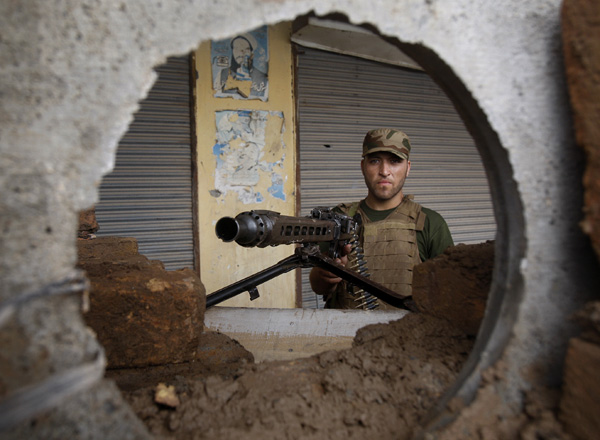
A Pakistani paramilitary soldier poses for a photographer at a checkpoint after authorities reopened a road in Bara, a town in the Pakistan Khyber Tribal region along the Afghan border, on Saturday. More than 150,000 government troops have been deployed to the border area in recent years. Mohammad Sajjad / Associated Press |
Editor's note: China Daily continues its series of reports and human interest stories from neighboring countries in an effort to provide insight into topics relevant to China. Pakistan is the second installment.
Pakistan's military says it has made progress in cracking down on Taliban terrorists, deploying large numbers of soldiers along its northern borders and reclaiming land from local fighters.
In recent years, Islamabad has also been emphasizing economic development as a means of combating further extremism.
Lieutenant Colonel Abid Ali Askari, additional director of Inter Services Public Relations, said that Pakistan has deployed more than 150,000 troops along the border with Afghanistan to help eradicate terrorist organizations, including the Taliban. As a result, the Taliban-controlled area in the north of Pakistan has shrunk from 14,900 square kilometers in 2008 to 1,200 sq km this year, the official said.
However, Askari said Pakistan was building on military gains by investing in the region's economic development, with the aim at exterminating local terrorism.
The Pakistani military's war with the Taliban has never been an easy one. The country's "inhospitable terrain" is a natural obstacle to military deployment in tracking terrorists and border trespassers. Mountainous or hilly terrain accounts for more than half of the country's territory.
Extreme weather, fragile communication infrastructure and the lack of civic amenities in the federally administered tribal areas along the border are also hampering the fight against terrorism, Askari said.
In addition, Pakistan is located at the crossroads of the continent, bordering India to the east, Iran and Afghanistan to the west, and China to the north.
Its geopolitical location poses challenges for the Pakistani authorities in their efforts to control trespassers and prevent foreign terrorists from entering the country, analysts said.
It is particularly difficult for the Pakistani military to monitor the mountainous border with Afghanistan, Askari said.
"Cross-border trade, commerce and intermarriages are common practices in the area, and tribal people move across the border freely," he said.
An estimated 12,000 vehicles and 31,000 people cross the Pakistan-Afghanistan border through various routes in Balochistan province every day, according to statistics provided by Askari's agency.
Economic revival
Pakistan has paid a huge price in terms of military casualties. "Pakistan has lost 3,699 soldiers, while the other nations, including members of NATO, have lost 3,254," he said. Pakistani soldiers must also cope with longer deployments than soldiers from other countries - 26 months on average.
In the hope of building on the hard-won military gains, Pakistan is now putting energy into social and economic development projects, an approach it sees as a "softer" solution to terrorism. Greater prosperity can help locals resist the temptation of earning money from terrorist activities, Askari said.
Projects to improve living standards are a pillar of the revival plan for the region, aimed at bringing more income to less developed areas. As part of the new strategy, the Pakistani government has financed poultry and cattle farms, and established markets to boost local trade.
Despite the country's difficult terrain, a 600-km road is being constructed in Pakistan, aimed at facilitating business links to poorer areas.
"About 265 km of road have been completed and 213 km are under construction," Askari said.
Development of national transportation "is now of great security significance" for Pakistan, said Hu Shisheng, director of the Institute of South and Southeast Asian and Oceanian Studies at the China Institutes of Contemporary International Relations.
"A public transport network that connects the whole country can help ensure national security and prevent violence and turbulence," Hu said.
However, analysts said there is still a long way to go because "various international players" are supporting the terrorists in Pakistan.
In a blast in the southern city of Sukkur on July 24, at least six people were killed and more than 35 others were injured when unknown militants attacked Pakistan's Inter Services Intelligence Agency, local media and police said.
"There are so many vested interests in the region at this point in time, creating new plots and conspiracies," said Najam Rafique, director of the Americas department at the Institute of Strategic Studies in Islamabad.
Rafique said the lack of incentives and the poor security situation make it difficult for foreign investors and enterprises to come to Pakistan.
"The problem lies here in the country, which needs to implement policies that can create investor confidence," Rafique said.
zhangyunbi@chinadaily.com.cn