Alaska studies glacier's surges
|
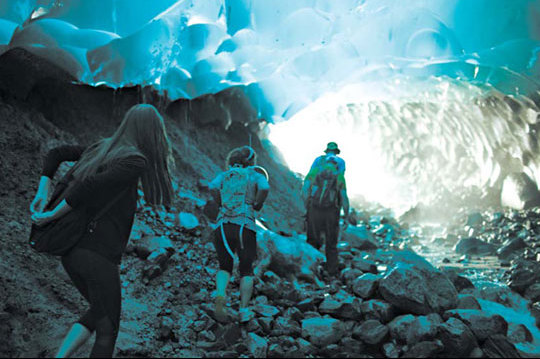
"Glacier leap," or melting that leads to a sudden release of water, is occurring at Mendenhall Glacier in Juneau. Photograph by Matthew Ryan Williams for The New York Times |
JUNEAU, Alaska - The idea that glaciers change at a glacial speed is increasingly false. They are melting and retreating rapidly all over the world. But the unpredictable flood surges at the Mendenhall Glacier, about 20 kilometers from downtown Juneau, Alaska's capital, are especially worrisome as global temperatures and climate variability increase.
Starting in July 2011, and each year since, sudden torrents of water shooting out from beneath the glacier have become a new facet of Juneau's brief, shimmering high summer season. In that first, and so far biggest, measured flood burst, an estimated 37 billion liters gushed out in three days, threatening homes and property along the Mendenhall River that winds through part of the city. There have been at least two smaller bursts this year.
"That first one caught us by surprise," said Tom Mattice, the emergency programs manager and avalanche forecaster for Juneau.
That the Mendenhall Glacier is thinning, and has been for decades, is only part of the explanation. Water from snowmelt, rain and thawing is are also combining in new ways, researchers said - first pooling in an ice-covered depression near the glacier called Suicide Basin, then finding a way to flow downhill.
What prompts a surge - and the urgent search for a way to anticipate and prepare by scientists and safety officials like Mr. Mattice - is pressure. As water builds up in the basin and seeks an outlet, it can lift portions of the glacier ever so slightly, and in that lift, the water finds a release. Under the vast pressure of the ice bearing down upon it, the water explodes out into the depths of Mendenhall Lake and from there into the river.
Glaciologists even have a name for the process, which is happening in many places all over the world as climates change: jokulhlaup, an Icelandic word usually translated as "glacier leap."
"We don't have a sense yet how much of a threat this poses, or how much water you could store up there," said Jason Amundson, an assistant professor of geophysics at the University of Alaska Southeast, in Juneau.
What elevates the concern is the proximity of people. Glaciers may be leaping in many places, but it happens mostly in isolation. The roughly 20-kilometer-long Mendenhall, by contrast, is one of the most visited glaciers in the world, and an urban one. About 400,000 tourists a year, 80 percent of them from the cruise ships that stop at the Port of Juneau, are drawn to the glacier.
"We're a drive-up glacier," said Nikki Hinds of the Mendenhall Glacier Visitor Center, which is operated by the United States Forest Service. "In how many places can you have that?"
This summer, glacier-monitoring intensified. A pressure transducer to gauge water buildup was installed in a deep crack on the edge of the basin, with a satellite link sending back real-time data about the glacier's hidden waterworks. A time-lapse camera was also positioned at the main pooling site for the first time to track bulges in the ice that could suggest dammed-up water.
Like glaciers the world over, the Mendenhall has thinned and retreated more than a hundred meters since visitors first started coming here in the late 1800s. Long-term climate models suggest a warmer, wetter pattern in this part of Alaska, which could have its own strange ripple of consequences for the Mendenhall and the people who love it, study it and live by it.
Jamie Pierce, a mountaineer and researcher at the university, was out on the Mendenhall ice on a recent afternoon, checking the instruments. After rappelling about 15 meters to the transducer, he found it completely dry, suggesting that the water was finding another channel or another damming point, other than the one suspected of causing the trouble.
Mr. Pierce said, "The biggest thing we don't know is what's blocking what."
The New York Times