Pipeline to boost natural gas supply
|
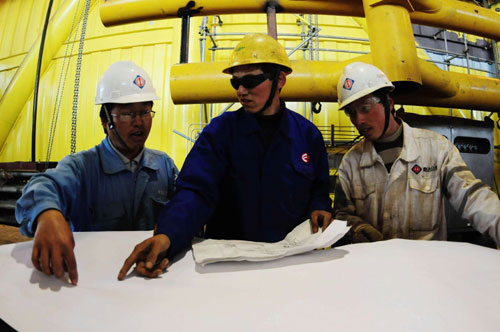
China National Offshore Oil Corp, the country's largest offshore oil and gas explorer, said on Thursday it has completed the key controlling project of the second phase of the pipeline. The whole project will be finished by the end of the year. Yu Fangping / For China Daily |
Businesses operating in Pearl River Delta area will benefit
China's imported liquefied natural gas and domestically produced resources in the South China Sea will increasingly be supplied to the energy-hungry Pearl River Delta area after the completion of a pipeline in Guangdong province.
China National Offshore Oil Corp, the country's largest offshore oil and gas explorer and biggest LNG importer, said on Thursday it has completed the key controlling project of the second phase of the pipeline. The whole project will be finished by the end of the year.
"It is expected to deliver about 4 billion cubic meters of natural gas produced from CNOOC's Liwan 3-1 block in the South China Sea and 3 billion cubic meters of imported LNG from Zhuhai receiving terminal annually to the cities of Zhongshan and Zhuhai in Guangdong province," said Wang Ge, general manager of Guangdong Natural Gas Grid Co Ltd, owned by CNOOC Gas & Power Group.
Around 60 percent of the total 7 billion cubic meters of natural gas will be used for power plants. The rest will be supplied for residential use, according to Wang.
During the 12th Five-Year Plan period (2011-15), the company plans to build a new natural gas pipeline of about 2,000 kilometers, enabling an annual natural gas delivery capacity of 60 billion cubic meters in the province.
By the end of 2020, the total length of the new natural gas pipeline will be about 2,768 km.
Wang said total investment in the Guangdong natural gas pipeline is 50 billion yuan ($8 billion). Preliminary work is under way on these later phases of the pipeline.
"After completion, together with China's West-to-East natural gas transmission pipeline, Guangdong's natural gas pipeline will help to form a comprehensive network within the province," said Wang.
Guangdong used 10.6 billion cubic meters of natural gas in 2012, 82 percent of it from CNOOC. The rest was supplied mainly by PetroChina Ltd, the country's largest natural gas producer.
"South China has become a rapidly developing emerging market for natural gas since 2005," said Li Li, a senior analyst at ICIS C1 Energy, a Shanghai-based energy information consultancy. "When there is more supply, there will be more application facilities for more consumption. In Guangdong, the users are mainly power generators. Its use in the auto and chemical industries is still at a very low level."
She said unlike the northern China region, which is heavily dependent on domestic production, the natural gas supply in southern China is relatively stable because of imports.
So far, CNOOC has four LNG fully operational receiving terminals - in Guangdong, Fujian, Shanghai and Zhejiang. They have an annual receiving capacity of more than 18 million metric tons in total.
Another four terminals in Zhuhai, Tianjin, Hainan and Shenzhen will be put into operation within the next two years. By then, CNOOC will have an annual receiving capacity of 30 million metric tons.
Last year, China's imported LNG amounted to 14.5 million metric tons, 74 percent of which was imported by CNOOC.
The Myanmar-China natural gas pipeline started deliveries on Sunday after three years of construction, helping to diversify the country's energy import channels.
The 793-kilometer pipeline starts at Kyaukpyu on Myanmar's western coast and enters southwestern China at Ruili in Yunnan province.
The owner of the pipeline, PetroChina, said a parallel oil pipeline, expected to deliver oil by the end of this year, is 94 percent complete.
Completion of both pipelines will bring 22 million metric tons of crude oil and 12 billion cubic meters of natural gas annually into China.
The oil pipeline will become China's fourth important import route, joining completed pipelines from Kazakhstan, Turkmenistan and Russia.
At present, China's natural gas consumption accounts for 5.5 percent among its primary energy mixture, 18.4 percentage points lower than the global average level.
To cope with climate change and reduce carbon emissions, the government set a target to increase natural gas consumption to 8.3 percent of the energy mixture by 2015.