


US export bank chief sounds alarm
|
Fred Hochberg, chairman and president of the Export-Import Bank of the United States, chats with a member of the audience after his speech at the Center for America Progress on Tuesday in Washington where he discussed the bank's annual competitiveness report. Chen Weihua / China Daily |
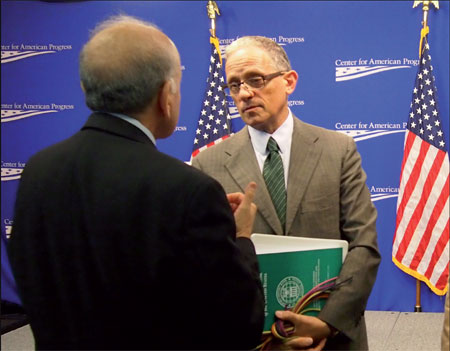
Fred Hochberg, chairman and president of the Export-Import Bank of the United States (Ex-Im Bank), does not necessarily approve of the practices adopted by his counterparts in countries like China, Russia and the Republic of Korea, but he clearly wishes that Congress would let his bank be just as aggressive as they are.
He blasted Republicans in Congress who tried to close the Ex-Im Bank as early as next September.
"And let me remind you that China, Russia, Korea and Japan are not having this debate," Hochberg said at the Center for America Progress in Washington on Tuesday.
"Their export credit agencies are here to stay. They don't require a bruising Congressional fight every two or three years. They simply resolve to do what it takes to win in global markets," said Hochberg, who started at the job in 2009 and was recently confirmed by the Senate to serve another four year term.
The Ex-Im Bank, established in 1934 to provide loan guarantees to foreign firms that wanted to do business with US exporters, has been called by its domestic detractors a Fannie Mae for exporters. Others describe it as a pillar of the economic patriotism President Barack Obama pledged for his second term.
Heritage Action, a sister organization of the Heritage Foundation, has accused the bank of distorting markets by backing risky loans with taxpayer dollars and using the guarantee of taxpayer money to back politically favored companies and projects. The bank's contribution to total exports, it said, is negligible.
Some Republicans call the bank a slush fund for a few big companies, citing that out of its $14.7 billion in long-term loan guarantees for fiscal year 2012, $12.2 billion (or 83 percent) was used to subsidize sales of Boeing airplanes.
Despite a growing loan guarantee capacity authorized for the bank in recent years, Hochberg is not satisfied.
"In this year's competitiveness report, we found that China, Korea, Japan and others are ramping up government export support," he said.
"Last year alone, Korea Ex-Im increased its total financing volume to almost $64 billion worldwide, nearly twice the $36 billion the US provided, and this from a nation with a GDP far less than ours," he said.
The 2013 competitiveness report by the bank claimed that the global financial crisis had upped the ante everywhere, citing Russia's aggressive push to be the world's leading exporter of nuclear power.
It said that the developed world, mostly Europe, is no longer the most formidable competitor for the US.
"Manufacturing prowess has vastly improved in Asia," he said. "Due to their product innovation and huge capacity investment, Asia has gone from customer to competitor as well."
Hochberg called China the most formidable competitor, citing China's plan to build a 150-seat aircraft to compete with the medium-sized passenger jets Boeing and Airbus sell worldwide.
"As I travel the world on behalf of American companies, I know China, Brazil, Russia and Korea, are right behind me. These nations are a serious competitive threat," said Hochberg.
While Hochberg claims that the US still holds great advantage in its ingenuity, openness, honesty and transparency, the 2013 Global Manufacturing Competitiveness Index last year showed the top five most competitive nations five years from now will be, in descending order, China, India, Brazil, Germany and the US, compared with last year's ranking of China, Germany, the US, India, and the Republic of Korea.
Hochberg suggested that China is building soccer stadiums in sub-Saharan Africa in a bid to win business deals there, but he did not explain how such Chinese foreign aid projects differ from many by USAID.
Despite complaints expressed by Hochberg, China has remained one of the fastest growing markets for US exports.
A recent report from the US-China Business Council showed that US exports to China grew 294 percent from 2003 to 2012, compared to the 111 percent growth it registered in the rest of the world.
The figures do not include US exports to Taiwan and Hong Kong. Hong Kong alone bought $35 billion in goods from the US in 2012.
USCBC President John Frisbie said after the release of the report that the US-China trade relationship strengthens America's economy and creates well-paying jobs for many American workers across the country.
"US exports to China remain a bright spot for many US companies, particularly with European demand weakening," he said.
chenweihua@chinadailyusa.com
















