For a healthy milk food competition
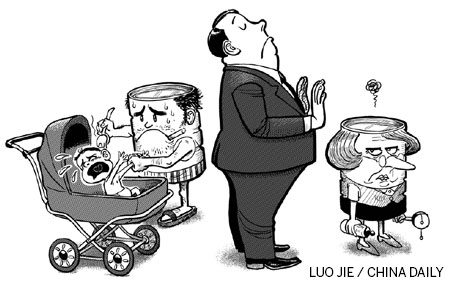
The government recently launched an investigation into the alleged monopoly practices of some foreign baby milk formula producers, which is widely viewed as an official intervention to protect domestic companies.
The prices of the baby milk powder produced by some foreign brands have increased by up to 60 percent. But this is only a symptom of the problem facing domestic producers. Foreign brands have raised their prices because of the demand for their products. Foreign baby milk formulas cost twice as much as domestic products, but Chinese parents still buy them because they believe them to be safer than local ones.
Despite the growing market for baby milk formula, domestic brands have failed to cash in on the demand because they have lost the trust of consumers after a series of serious food safety scandals since 2008, when at least six children died and thousands fell ill after consuming chemical-contaminated milk powder. Although the market for milk formula grew by 25 percent from 2011 to 2012, the sales of Mengniu, one of China's largest producers of dairy products, declined by 3.5 percent, because it was one of companies involved in the 2008 milk scandal.
The Chinese mainland market for infant formula is huge. It has grown by more than 20 percent a year since 2007 - even in 2008, which saw the worst baby food scandal, the market grew by 33 percent. The prime reason for the growing infant formula market is that only 28 percent of the infants aged up to 6 months are breast-fed on the mainland and the number of mothers choosing to breast-feed is declining.
Euromonitor estimates that the market for baby milk formula will double in four years and will be worth $25 billion, with sales on the mainland accounting for 50 percent of the global market.
But despite allegations that some foreign brands have been taking advantage of parents' growing trust in the safety of their products, consumers are not likely to fall back on domestic brands until they are convinced that their products are as safe as those produced by their foreign counterparts. That's why Mengniu recently finalized a joint venture agreement with French food producer Danone, which realized 16.1 percent increase in its infant nutrition products globally in the first quarter of 2013.
However, rebuilding their reputations is likely to be an uphill task for many domestic brands.
The anti-monopoly investigation launched by the National Development and Reform Commission, China's top planning body, focuses on the alleged price fixing and anti-competition practices of some baby milk formula producers. But the bottom line is, consumers care more about the safety of their children than the price of infant formula, which means that government intervention to ensure the safety of domestic products is more important than the current price-fixing probe. In fact, government intervention could actually prove counterproductive if it is only aimed at helping domestic brands.
Jian Aihua, a food industry researcher with CIConsulting, says the high price of foreign brands has worked to the advantage of domestic milk powder producers in second- and third-tier cities where the average income is lower than in first-tier cities. "If the prices of infant formulas produced by foreign brands drop (foreign companies have responded to the anti-trust probe by lowering prices by up to 20 percent) and domestic brands cannot win back the trust of consumers, the market share of foreign brands, which is now less than 50 percent, will become larger." Jian says.
It is not just the safety issue that is a challenge for domestic companies. Growing incomes in China and its expanding middle class may also strengthen customers' preference for foreign brands, says Mei Xinyu, a senior researcher with the Ministry of Commerce. With China's per capita income rising, China's middle class consumers are simply following the global consumption trend by preferring better, safer infant formulas.
The government should focus on protecting consumers' rights and interests, instead of only trying to protect domestic milk formula producers. The rising prices of foreign infant formulas can be explained by a simple law of economics: the demand for them is higher than the supply. Therefore, the government has to take measures to ensure domestic infant formulas are absolutely safe to enable domestic brands to win back people's trust and compete with their foreign counterparts on the strength of their products' quality as well as price.
The author is a writer with China Daily.