Portable solar chargers enter mass market
|
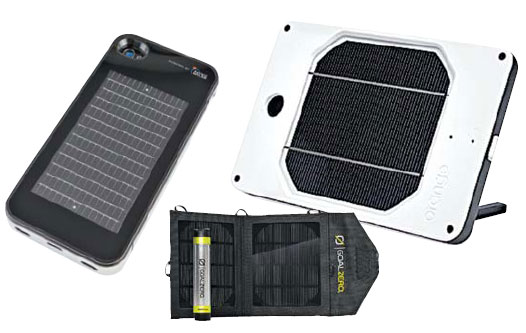
From left, EnerPlex's solar-charged case costs about $80; Goal Zero's recharger kit is $100; and Joos Orange's standalone charger costs $150. |
Life is becoming increasingly mobile thanks to smartphones and tablets. The possibilities for this kind of connected living could be endless - if only the batteries lasted long enough.
Now, a range of solar technology companies are offering small, portable chargers and accessory cases that provide power on the go. Some are on the market already, while others are still in development.
"A mobile life demands mobile power," said Chris Abbruzzese, vice president for marketing at Goal Zero, which makes a number of solar charging systems, including a kit whose battery can take attachments to become a headlamp, flashlight or fan. "We sort of have the motto: Life doesn't stop; why should your gear?"
Devices incorporating solar cells or panels into cellphone cases have been available for some time, but it has been a challenge to bring form, function and price to the right levels, analysts say. Not only were earlier models too bulky and expensive, but they also often took too long to charge, especially in the face of improving battery technology.
"In general, the market for aftermarket batteries has not been great, because until now, for the most part, battery life has been getting a little bit better," said Stephen Baker, vice president for industry analysis at NPD Group, which tracks consumer behavior. But neither has the solar-power market been great, which helps explain the solar push into mobile consumer electronics in the face of what some see as tough odds.
"The solar companies are rushing there, and the reason why is because the margins in the conventional markets are really bad," said Matt Feinstein, an analyst at Lux Research, which specializes in emerging technologies.
A range of chargers, some selling for less than $100, is becoming widely available. Some, like the Solio Bolt or the Joos Orange, use a stand-alone solar-charged battery pack that connects to devices through a USB cable. Others, like Ascent Solar's EnerPlex, use the sun to charge a case, which then can recharge the smartphone.
There are signs that the products are beginning to find an audience. Goal Zero says it expects its revenue to double this year to about $60 million. Ascent Solar says its sales began taking off after Fry's, an electronics chain based in California, began carrying EnerPlex chargers.
The companies have come to the mobile charging business in different ways. Goal Zero, for instance, grew from the humanitarian efforts of Robert Workman, an entrepreneur active in bringing renewable power to parts of the Democratic Republic of Congo.
The company uses monocrystalline silicon in its portable panels, which fold into the size of a CD case. Because of the collapse in silicon-panel manufacturing prices, the company can now offer its products at half to a third of what they cost three years ago, said Joe Atkin, its chief executive.
For Ascent, the path was different. Faced with low-cost Chinese panel makers, Ascent pulled back last year from its original plan to develop photovoltaic materials for buildings and solar farms. Instead, the company decided to focus on consumer electronics, where profit margins are higher and the pressure to produce in high volumes is lower.
The company relies on so-called thin-film products made from the compound copper indium gallium selenide, or CIGS, which can work on flexible material rather than the glass generally used to support traditional silicon cells. That makes the material well-suited to applications like cellphone cases, executives said.
Alta Devices, based in Silicon Valley, is pursuing the electronics business for similar reasons but employs a different technology.
Alta uses gallium arsenide, the most efficient solar compound, on flexible backing. The material is still under development, but the company already does business with the military. A big focus is on prototypes for charging cases for smartphones and tablets.
"When you really make a meaningful difference in how long the battery lasts or how something gets powered, these can become very high-adoption-rate markets," said Christopher S. Norris, Alta's chief executive. Given how many devices need charging, he said, "these things begin to become billion-dollar markets in a very short amount of time."
The New York Times