More places at elite universities for rural students
|
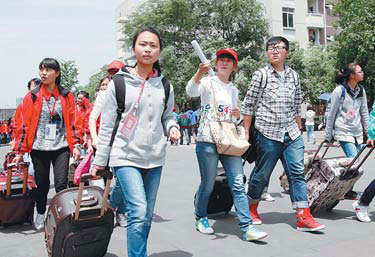
High school seniors from Tianquan county in Yaan, Sichuan, walk onto their new campus at Chengdu Normal University in Chengdu on April 24. The county's 1,019 students, affected by the magnitude-7 Lushan earthquake, will attend the national college entrance examination next month. Wang Ruobing / for China Daily |
Major universities have been urged to enroll more students from rural areas in a major effort to promote equality in education.
Meanwhile, educational analysts urged the government to launch long-term policies to improve the education level of rural students.
The State Council released a statement on Wednesday promising the government will offer more opportunities for higher education to hard-working students in rural areas.
The government decided to increase the quota of students from least-developed areas attending key universities to 30,000 this year, exceeding its original target of 10,000, the statement said.
The additional students should mostly come from central and western regions, where colleges are limited and competition for places is fierce, according to the statement.
To solve the education inequality problem, China announced that 10,000 places in prestigious universities would be open to students in high-poverty regions every year.
An official in charge of recruiting students at China Agricultural University, who identified himself only as Zhou, said his university already leaned toward the central and western areas, giving more opportunities to students from the likes of Henan and Sichuan provinces.
"The university will surely continue to see a rising number of students from less-developed areas this year with the country's ambitious recruitment target," he said, without providing a specific number.
"Most majors in the universities open to students under the recruitment plan are related to agricultural sciences such as animal medicine and plant production, which will be very useful to local development if they go back to work in their hometowns."
Chu Zhaohui, a senior researcher at the National Institute of Education Sciences, said the proportion of students from China's rural areas attending key universities is rather low.
"This unfair situation is partly rooted in big differences in basic education between rural and urban regions," he said.
For instance, he said, China needs to strengthen its input on teaching staff, who are in seriously short supply in rural areas.
Tan Zheng, a teacher in Southwest Guizhou province's Qianxi county, recalled that two of his students received offers from Guizhou University through the program.
"Both were doing really well but didn't get ideal results in the college entrance examination due to too much pressure," he said.
Tan believes the program will provide a second chance for those who didn't do well in the examination. "It's important for rural students because they study really hard at school."
An official from the testing service bureau in Taibai county, Shaanxi province, who did not want to be identified, said 45 students in the county applied for the recruitment plan this year, a slight decrease from 2012.
"All the students who applied for the plan last year failed to meet the entrance requirements for those famous universities, which partly caused a fall in applications this year," he said.
Li Chang'an, a public policy professor at the University of International Business and Economics in Beijing, said less-developed areas with fewer education resources, will receive more benefits due to the policy.
"But for long-term development, the country should give more supportive policies to upgrade education resources in less-developed regions, such as building more top-class universities," he said.
"When the country can solve the distribution problem of educational resources one day, the equality in education will be more easy to realize," he said.
Ma Lie in Xi'an and Zhao Kai in Guiyang contributed to this story.