China cuts US bond holdings
|
A clerk inspects dollar notes at a Bank of China outlet in Nanchong, Sichuan province. China reduced its holdings of US Treasury bonds slightly in March. Xinhua |
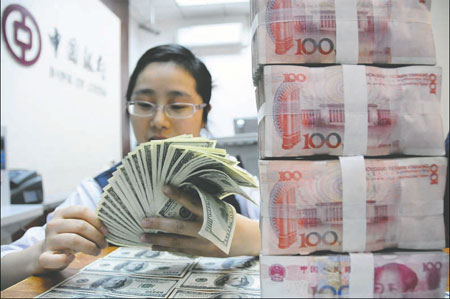
China, the United States' top foreign creditor, slightly reduced holdings of US Treasury issues modestly in March despite an overall increase in demand among foreign investors, according to data released on Wednesday.
The Treasury Department said China and No 2 creditor Japan each reduced by a modest 0.1 percent their holdings of US government-issued debt - to $1.25 trillion and $1.11 trillion, respectively.
Many other foreign governments and private investors increased holdings of long-term US Treasury securities in March.
Net purchases by foreign residents, which includes banks and other financial institutions, were $15.3 billion, according to the latest monthly Treasury International Capital, or TIC, report. Net purchases by private foreign investors totaled $9.7 billion, while the figure for foreign official institutions was $5.6 billion.
Ira Jersey, an interest-rate strategist at Credit Suisse Group AG, said the 0.1 percent month-to-month reduction by China isn't very significant.
"In general, we are expecting general inflows to continue into the Treasury market from foreign - official and private - sources, although at a slower pace than we had in the last few years, partly because investors are looking at somewhere to get better yields," he said.
Despite being a major holder of US government debt, China's hasn't been the biggest foreign buyer, Jersey pointed out.
"Other regions in aggregate have been larger buyers for some time," he said.
Members of the Organization of the Petroleum Exporting Countries, for example, were leading purchasers of US Treasurys when oil was selling around $100 a barrel "because they had a lot of money from exporting oil to the US," the analyst explained.
"A lot of the flows we've seen have been from Europe because they [investors] don't want to own government bonds in Europe."
Some investors, including Peter Schiff, CEO and chief global strategist for Euro Pacific Capital Inc, have criticized the ongoing Chinese purchase of US government bonds, saying the US shouldn't rely on China as its bank.
But Jersey said a fine "balance" is needed somewhere when two countries have a large trade deficit. The US was on the short end of a $315 billion trade gap with China in 2012.
"If one country has a trade deficit to somewhere else, they have to get a financial inflow from somewhere," he said.
"As long as there is a policy of having a currency board and having the renminbi stay within a certain band to the dollar, then China has to buy dollars if they have a trade surplus with the US," he said. "And if they don't do that, the only other option is to let the renminbi appreciate, given there is no other way of shrinking the trade deficit."
Also on Wednesday, a senior Treasury Department official said currency-rate policies in some emerging markets affect global growth.
"Global recovery has been held back by a lack of demand growth in many of the major advanced economies, and by resistance in many emerging economies to moving more quickly toward the currency flexibility needed for a durable rebalancing," Lael Brainard, Treasury undersecretary for international affairs, said at a Bretton Woods Committee conference hosted by the International Monetary Fund.
"As a result, it runs the risk of being overly dependent on the recovery in the US," she said.
In its most recent report on exchange-rate policies, issued in mid-April, the Treasury Department again declined to label China a "currency manipulator" although it said the yuan needs to appreciate further.
"China has taken a series of steps to liberalize controls on capital movements, as part of a broader plan to move to a more flexible exchange-rate regime," that report said.
As of early April, the yuan had appreciated 10 percent against the dollar since June 2010, when China moved off its exchange-rate peg.