Respect for women begins at home
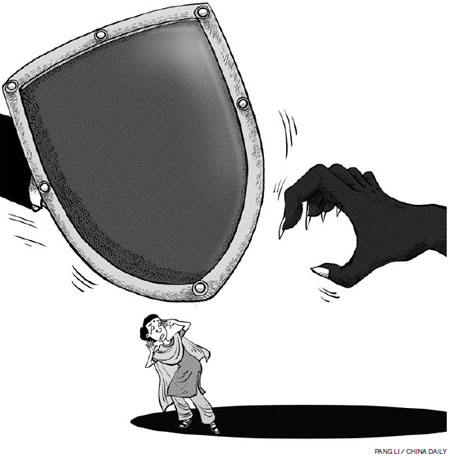
India has been in the news recently for all the wrong reasons: corrupt officials and ministers, nationwide protests against corruption, falling economic growth rate and most recently the rape of a 23-year-old paramedical student on a moving bus in the capital New Delhi.
The incident is too gory and barbaric to be repeated here; suffice it to say that the victim was raped, battered and thrown out of the moving bus on the night of Dec 16 and breathed her last on Dec 29 in a Singapore hospital where she was flown a couple of days before. Five of the six accused in the case face trial for abduction, rape and murder. The sixth is a minor and will be tried in a juvenile court.
Many rapes have been reported from India after the one in New Delhi but none have forced Indians across the country to take to the streets in such large numbers. This may suggest that rapes are rare in India and Indians react vociferously, even violently as we recently saw in Delhi, against rape. Neither, however, is true.
Rapes are as common in India as any other country. In fact, it has one of the highest incidents of rape in the world. Many may cite statistics to say that reported rapes for each 100,000 of the population in India is just 1.6, whereas the corresponding figures for the United States, the United Kingdom and Sweden (all developed countries) are 32.3, 26.4 and 25.2. But there is a catch here. The social stigma attached to rape in India is so horrid that most of the rape victims (or their parents and relatives) hush up the crime and suffer in silence.
Then there is the problem of police even for victims who are bold enough to face the world to seek justice. Local police are reluctant to register complaints against rape. If the victim comes from a poor family, police could even refuse to file a case. Matters can get worse for the victim if the accused is rich or politically influential. In such cases, instead of registering a case against the accused, police register a complaint against the victim or her family and even put them behind bars.
Besides, even if a court takes up a rape case, the accused can be granted bail and return to threaten the victim and/or her family with dire consequences if she does not withdraw the charges. And by the time justice is delivered, which is not often, the social stigma devastates the victim and her family.
This should give a rough idea of the pathetic situation rape victims and their families find themselves in India. The situation, however, may not be very different in many countries, including China.
It is common knowledge that women shudder to venture out after dark in many Indian cities even during emergencies. Many of them have to suffer the dirty looks, abusive comments and groping hands of men while traveling in public transport almost daily. Perhaps the New Delhi rape case brought out the fight in women and their fathers, brothers and husbands to seek justice and end it all.
But the problem in India, as in other parts of the world, is not only with rape and evident violence against women. The problem is with people's mindset, and it starts at home.
The preference for sons over daughters, neglect of the girl child and female feticide (although it is banned) is where the problem starts. Boys growing up in most households realize very early the power they wield over their parents and, therefore, society irrespective of whether their family is rich or poor, educated or illiterate, powerful or weak. This instills in them a sense of false importance about their gender.
But as they grow up and venture into the wider world, this false importance becomes part of their psyche as they see male dominance everywhere, from academics and jobs to law enforcement and politics.
But India is not the only country that suffers from this social malaise. Perhaps no country is free of it. China, too, has its gender problems. The preference for sons, the declining man-woman ratio, the bias against women in certain jobs, the preference for "beautiful" rather than qualified, intelligent and efficient women in certain professions, and domestic violence against women all add up to China's gender problems. And despite rape not being as rampant in China as in some other countries, it is not an unheard of phenomenon.
The problem in China is then not very dissimilar to that in India. India's National Crime Record Bureau's figures for 2011 show that as many as 94 percent of the rapes were committed by people who were known to the victims. Surprisingly, 8.1 percent of the 94 percent perpetrators were close family members or other relatives, and 34.7 percent were neighbors and community members.
The accused in the New Delhi rape case were strangers to the victim, so better police patrolling and vigil (as many of the protesters demanded) will not solve even half the problem.
Of course, women need better social and legal protection. But that has to start at home in the way we bring up our children, in the education that schools and colleges impart, in the way husbands behave with their wives, in the way fathers treat their daughters. The greater part of the responsibility, however surprising it may seem, lies with women because they have to teach their sons to not see and treat women as objects. This is as true for India as it is for China.
The author is a senior editor with China Daily.
Email: oprana@hotmail.com