Need for quality logistics space up
|
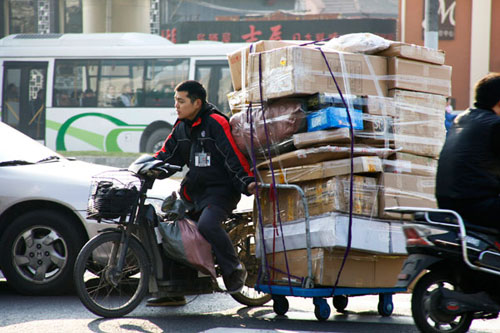 An S. F. Express employee riding a tricycle to deliver parcels to customers in Shanghai. The booming e-commerce market is fuelling demand for logistics services in China, a market that is characterized by a severe shortage of modern logistics stock. Gao Jianping / For China Daily |
Higher rental, inadequate supplies may force companies to seek new sites
The rapid growth of the e-commerce sector in China has triggered demand for quality logistics space, with demand often outstripping supply, says a recent market report from real estate service provider DTZ.
According to the report, China is set to overtake the United States as the largest e-commerce market in the world by 2015, driven by rising domestic consumption, a fragmented retail market and an expanding number of Web users. By 2015, the number of Internet users in China will rise to over 700 million from the present 500 million, making it the largest e-commerce market in the world, it said.
However, the growing market will also create challenges for e-commerce companies as they will need to find ways to make more efficient deliveries to the more than 220 million online shoppers in China to stay ahead. Limited infrastructure, lack of warehouse space and the shortage of last-mile delivery expertise often makes it difficult for e-commerce companies to provide efficient services in the lower-tier cities and inland areas.
For investors and developers, the scarcity of suitable land is also an ongoing issue. Investors should consider investing in large companies with existing land banks, or in those that are redeveloping old facilities, the report said.
The booming e-commerce market has also transformed the supply chain from being supply-driven to demand-led. This has important ramifications for logistics property in terms of site selection, specification and location.
"We see a growing need for the development of small warehouses adjacent to the city markets," said David Ji, head of Greater China research at DTZ.
Adding to the challenge is the severe shortage of modern logistics properties. Modern logistics facilities account for just 2 percent of the total stock in China, meaning that the majority of property comprises middle- and low-end premises, mostly converted from factories and poorly constructed facilities, with inadequate height, insufficient loading docks and restricted vehicle accessibility.
The lack of supply has also contributed to higher rentals in the first tier markets, with logistics rents going up by 85 percent in some districts of Shanghai during the past year. The higher rentals have prompted many e-commerce companies to relocate their warehouses to lower cost regions, the DTZ report said.
Goodman Group, an Australian developer that specializes in industrial real estate, announced recently that its new property development in the Chinese mainland during the third quarter would be around 260,000 square meters. The company said this also includes a 103,000 sq m pre-lease to a leading e-retailer.
"We are confident that China's economic outlook will remain robust due to the strong domestic consumption, a key driver of demand for prime logistics and warehouse space," said Philip Pearce, Goodman's managing director for Greater China.
Goodman has set a target for development of 800,000 sq m over the next 12 months and creating a land bank/reserve in excess of 4 million sq m, which has the capacity to deliver 2.7 million sq m of prime logistics space over the next three years.
The Internet is already an integral part of the retail experience for many Chinese, if not for the actual purchase then for conducting extensive research and price comparisons.
Online retail sales in China have grown annually at a rate of 99 percent in the past five years, compared with just 9 percent in the United States. In just one day in 2012 (Nov 11, otherwise known as "singles' day"), China's ecommerce market giant Taobao and its business-to-customer (B2C) platform, Tmall, generated gross sales in excess of 19.2 billion yuan ($3 billion) - 21 times the daily retailing volume of Hong Kong.
According to Ji, while the numbers are staggering, it is still far behind the actual potential as with only 37 percent Internet penetration the numbers are still well below those in the developed markets.
"The potential for growth is significant. Over 30 million new Chinese consumers - the equivalent of the population of Canada - are expected to make online purchases every year until 2015," said Ji.
However, the rapid growth of China's e-commerce market has often been underpinned by unique structural and demographic characteristics.
These include a limited physical retail network (online shopping has developed ahead of modern physical retail space in many markets, particularly in lower-tier cities), the rising power of the Chinese consumer, the rapid adoption of mobile Internet devices and government support (e-commerce is an integral part of the current five-year plan).
Contact the writer at huyuanyuan@chinadaily.com.cn