A tsunami in a Swiss lake
|
About 1,450 years ago, the population of Geneva at the time was small; today it is about 200,000. Damon Winter / The New York Times |
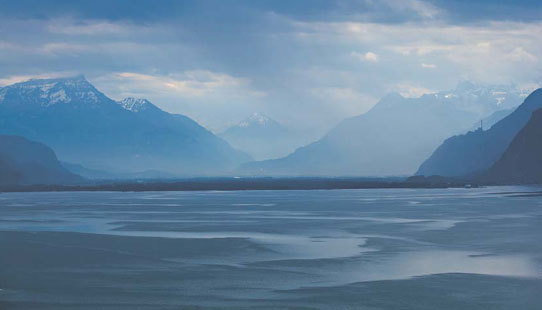
In the sixth century, Gregory of Tours, a chronicler of the Germanic people known as the Franks, told of an extraordinary event in what is now Switzerland, where the Rhone River spills into Lake Geneva.
He wrote of a big rockfall in the year 563 near a place called Tauredunum. The debris plunged into the river, and a great mass of water "overwhelmed with a sudden and violent flood all that was on the banks as far as the city of Geneva," more than 64 kilometers across the lake.
Historians and scientists have long believed that Gregory was describing a tsunami that raced across the lake, devastating part of Geneva. But there has never been direct evidence of it.
Researchers at the University of Geneva now say they have found that evidence, in the form of a large deposit of sediment in the middle of the lake. In a study published in the journal Nature Geoscience, they also suggest the sequence of events that caused the deadly wave: the rockfall hit the delta at the mouth of the river, causing this pile of accumulated sediment to quickly collapse into the lake and displace a huge amount of water.
"It's a bit like dropping stones into porridge," said an author of the study, Guy Simpson, a lecturer in the University of Geneva's department of geology.
Dr. Simpson said the thick lens-shaped layer of sediment, which lies more than 305 meters down in the deepest part of the lake, was found largely by chance. Katrina Kremer, a doctoral student and the study's lead author, was conducting seismic soundings, searching for thin sediment layers that might be evidence of major floods.
The researchers then took cores of the sediments and used carbon-dating techniques on organic matter in the cores - remains of leaves and bits of wood - to determine when the deposit formed, narrowing the range to a period between the late fourth century and the early seventh. The researchers estimated that the deposit, which is at least 10 kilometers long by 5 kilometers wide and averages about 5 meters thick, contains more than 248 million cubic meters of material. They ran computer simulations that showed that the collapse of that much sediment would have caused a tsunami of about 8 meters at Geneva.
Most tsunamis occur in oceans and are generated by earthquakes. But lake tsunamis are not unknown, said Richard A. Schweickert, an emeritus professor of geology at the University of Nevada in Reno.
Dr. Simpson said the Rhone delta sediments might collapse again someday and a resulting tsunami could be far more devastating. In the sixth century, Geneva was a small community; today it is home to about 200,000 people. "This reminds people that hey, hang on, these things have happened in the past, and quite likely will happen again," he said.
The New York Times