Govt plans to outlaw foreign educational consultants
|
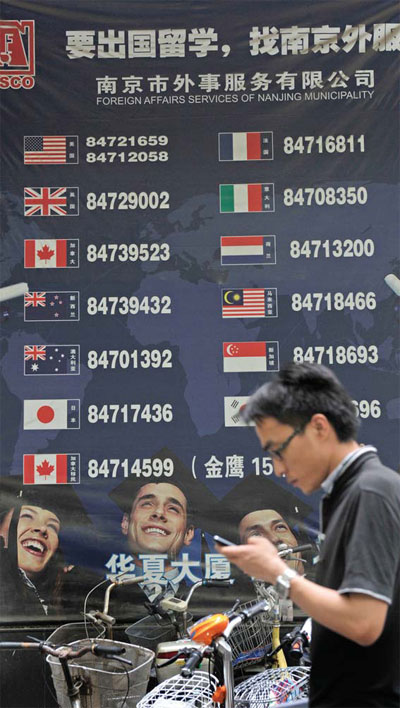
A man walks by an advertisement for a company that provides overseas study services for Chinese students, in Nanjing, Jiangsu province. New regulations are likely to ban international agencies from providing education-exchange services in China. An Xin / for China Daily |
Ministry's firm measures follow papers scam in New Zealand
International overseas educational consultancies are likely to be blocked from entering China under new regulations, a draft of which has been issued by the Ministry of Education.
Foreign institutions and individuals, representative offices of foreign institutions in China, foreign investment enterprises and cooperative schools of China and another country should not be able to engage in any form of intermediary agency activity providing educational exchange services in China, the ministry said.
The ministry has published the draft regulation on its website and is soliciting opinion from provincial-level educational authorities at yaojinju@moe.edu.cn until Nov 5.
The draft regulation allows provincial-level educational authorities to approve or reject qualifications of intermediary agencies, bans foreign agencies entering the market and strengthens supervision of the agencies.
The draft also requires each intermediary agency to set up an emergency fund of at least 500,000 yuan ($80,100; 61,800 euros), so that students can obtain refunds in the event of the agency being unable to provide services.
The ministry says the new rules are the result of some unqualified agencies providing advice to students wanting to study abroad that have helped some produce fake application materials or cheated them out of money.
In July New Zealand immigration officials found 279 applications submitted by Chinese students contained some forms of fraud, and said intermediary agencies were to blame for the fake material.
"I think the ministry is simply cutting foreign agencies out without good reason," says Chen Naibo, who works for an intermediary agency based in the US.
"If foreign agencies can forge materials or cheat clients out of money, domestic agencies can do so too," says Chen, who would not give the name of his company.
Chen's company mainly provides consulting to Chinese students who plan to attend high schools in the US.
"Since the students are too young to take care of themselves, most prefer living in a homestay, and we can find reliable homestays for them, which is much more difficult for agencies based in China," Chen says.
Li Jiayu, founder of USAdaxue.com, an overseas-study consultancy in Beijing, also criticized the proposed rules.
"I don't think foreign intermediary agencies should be banned from the market, because it is only competition in the market that makes good companies."
Li says the contingency fund was unnecessary.
"Intermediary agencies win the trust of clients by good word of mouth. If an agency is not good enough and has cheated clients, it cannot survive and will be out of business."
Li says that in a market-driven economy an industry association would be better in supervising the market.
"I think we should have an official association that can define what intermediary agencies do or should be and what kind of qualifications they need. The agencies would be able to renew their license annually under the association's guidance."
However, some domestic agencies offered their support for the proposed new rules.
"It makes the industry more transparent and reliable, and reduces the risk," says a staff member of an education agent based in Beijing, who declined to give her name.
Zhou Xiaohua, who set up her business on overseas consulting a year ago, says she welcomes the regulation, but disagrees with the proposed contingency fund.
Zhou says students sign a contract with agencies when they seek their services, so the students have legal protection should problems arise. If agencies forged material for students' applications, the agency would be breaking the law and would face punishment, she says.
In addition, Zhou says, some big intermediary agencies have thousands of customers a year, with charges for students of up to 50,000 yuan, so a contingency fund of 500,000 yuan makes little sense.
Zhou, who declined to give the name of her company, says: "Creating these rules will not be as effective as setting up an Internet platform that could share information among students preparing to study overseas, because this industry is more like an information provider, and setting up such a platform would give a lot of valuable information to students."
Many online bulletin boards such as Taisha and Chasedream already provide information on how to apply to universities overseas and tips on living aboard, Zhou says.
These are free and are popular among students preparing to study overseas, she says.
Shao Mingbo, whose son has been studying in the US, says the proposed ban surprised him.
"The regulation fails to take account of the fact that applying to a university in the US is extraordinarily complicated. It's quite different to applying to one in China.
"Foreign intermediary agencies offer many professional services to their customers, and banning them in China will heavily disadvantage students here."
While the idea behind setting up a contingency fund is good, he says, it will be pointless because in any case universities overseas would reject any student who provided fake application materials.
The number of Chinese students pursuing higher education in overseas universities was 339,700 last year and accounted for 14 percent of all the international students studying overseas, according to a report prepared by the Center for China and Globalization and published by the Social Sciences Academic Press in September.
Cheng Yingqi and Luo Wangshu contributed to the story.
liaoxue@chinadaily.com.cn