


Gearing up for knowledge economy
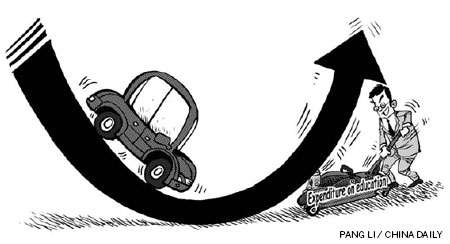
As countries progress toward higher income levels, their success or failure depends on their economies' ability to move up the production ladder from low-value-added manufacturing based on imported technology to high-value-added products less reliant on technology imports.
Numerous middle-income countries that were initially high economic performers struggled to make this transition. As their wages and other production costs increased, they could no longer compete with low-income countries, and with limited technological capacity and innovation, they could not compete with high-income countries either. In economists' jargon, they were caught in the "middle-income trap".
China is not considered to be in the middle-income trap, but its economy shows many similar symptoms. Wages have risen sharply, exports and growth are under threat, and many parts of the economy will need to move quickly to increase their value-added products and stay competitive.
The experience of countries that avoided the middle-income trap is highly relevant to China. What have others learned? Two crucial elements: education and innovation.
Avoiding the middle-income trap requires high levels of investment in human capital, research and development (R&D), information and communication technology (ICT), and flexible economic policies. It also requires a vibrant and innovative private sector.
The success of upper middle-income and advanced economies is without exception founded on strong and well-funded education systems. Basic education lays the foundation for other levels of human development. It needs to be equitably accessible to all regions and social groups. Its content provides the basis for creative thinking.
This year China is expected to spend about 2.2 trillion yuan ($347 billion) on education. Though it is expected to achieve the target of spending 4 percent of GDP on education for the first time, the percentage is still less than that of many other middle-income countries. Developed economies generally spend 5-7 percent of their GDP on education. China has made great progress on the education front and has pockets of educational excellence, as shown by the recent international ranking of its students' performance in Shanghai.
However, to ensure that high-quality basic education is accessible to all, expenditure on education has to be increased further. Studies suggest China can enhance students' problem-solving skills and creativity by moving from rote and exam-based learning to student-centered learning.
With production becoming more sophisticated, workers' technical and vocational skills are acquiring increasing importance. Skill development must be aligned with labor market needs and help enterprises respond flexibly to changing circumstances. China suffers from skill shortage in several sectors, and its aging population is likely to reduce rather than increase labor market flexibility. Hence, it has to pay more attention to skills and labor markets.
An independent, well-financed and high-quality tertiary education system is a hallmark of successful economies. Many European countries provide strong public financial support to universities, while in the United States leading universities have large private endowments. China's higher education system has expanded rapidly in recent years, but quality improvements have not kept pace. In relation to its size, China still has relatively few top-tier universities.
Education is only part of the challenge. Without a creative private sector, innovative economic activities will not be possible. Companies need incentives, financing, and the right policy and legal environment to act on innovative ideas.
Spending on R&D and ICT are crucial. China adopted a comprehensive R&D policy in 2006 and now spends 1.8 percent of GDP on R&D, which is set to rise to 2.2 percent by 2015. This is comparable to European economies' 1.9 percent but less than the Republic of Korea's 3.4 percent.
However, less than 10 percent of China's R&D is in ICT industries, while in knowledge-driven economies it is typically 25-50 percent. Moreover, most R&D in China is conducted by the government and State-owned enterprises, while private companies spend much less. And the link between R&D and manufacturing is weak.
Also, spending on R&D and ICT alone is not sufficient. Cutting-edge companies need to transform this spending into competitive production of knowledge and information-based goods and services. China has some highly innovative companies, particularly in telecommunications and consumer electronics, but the majority still focus on output rather than innovation.
Most high-income economies have an effective market place for innovative ideas, supported by public and private institutions and a range of financing options. In addition to university-based doctoral, post-graduate and research programs, many European countries have publicly supported funds to finance research, technology and innovation. In the US, wealthy private foundations complement government-supported basic research.
The link between research and private enterprises is vital. Innovative companies network with research institutions and have large R&D budgets. They provide incentives and working environments designed to attract talent and encourage creativity. Private equity and venture capital investors seek out innovative companies with potential to thrive in the market place.
China has built a strong foundation for progressing toward a knowledge-led economy. The 12th Five-Year Plan (2011-15) outlines an industrial policy that is expected to lead innovation-driven growth, spearheaded by seven strategic industries and supported by increased R&D spending.
However, much remains to be done. Liberalizing the financial sector and capital markets would broaden companies' access to finance while lowering the cost. More sophisticated capital markets would allow for an expansion of private equity and venture capital, which would in turn increase financing for innovative companies.
Small and medium-sized enterprises (SMEs) play a key role in China, generating 65 percent of patented inventions and 80 percent of innovative products. But SMEs have insufficient access to credit, which limits their access to skills and technology. Encouraging banks to lend to SMEs, and providing policies and training to support entrepreneurship would unleash a dynamic force in the economy.
The global economic slowdown has highlighted the importance of accelerating China's transformation to a knowledge-led economy. Many of the necessary reforms are set out in the 12th Five-Year Plan. But they need to be implemented decisively.
Robert Wihtol is director general of the Asian Development Bank's East Asia Department, and Yolanda Fernandez Lommen is head of the economics unit at ADB's China office. The views are the authors' own.
















