Development-first approach to Africa
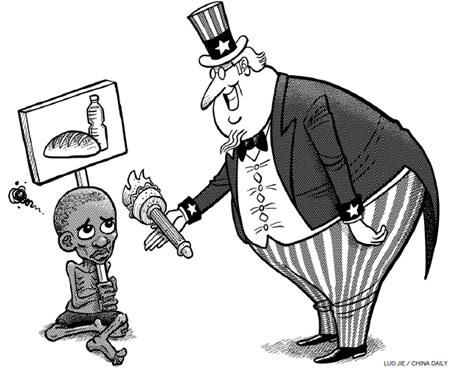
The ways and means by which the Chinese are penetrating the African continent are the subject of heated debates the world over, nowhere more so than in the United States. US Secretary of State Hillary Clinton's recent 10-day tour across Africa has brought the debates into focus.
In one camp are those who claim the Chinese are essentially behaving like neocolonialists, eager to exploit the continent's huge raw materials and mineral riches. They see the Chinese as keen on filling every nook and cranny left uncovered by Western multinational corporations.
On the opposing side, mostly outside the US and primarily in Africa and the emerging markets, are those who relish the rise of the Chinese and point to their successes as a belated form of economic justice. They believe that it is finally time for a non-Western power with deep pockets and a long-term time horizon to emerge as a viable partner for the continent.
Better yet, these voices argue, the Chinese, with their proposed trade-off of building infrastructure as compensation for tapping into raw materials, are only fulfilling what have turned out to be the century-old and empty promises of the Western powers.
Building railroads from inland areas to the coast. The eventual prospect of having a network spanning sub-Saharan Africa. Constructing highways and four-lane road networks at affordable prices across the continent. Having state-of-the-art office complexes, built within budgets that African countries can afford.These are all goals that African leaders have pursued for a long time. But in the past, a toxic combination of many African politicians' corruptibility, murky ties between former colonizing countries and their business elites and the new rulers, as well as overly complex planning structures more often than not have resulted in projects being prohibitively costly.
Given that Africa's economic growth has long been stunted by the lack of a dependable internal transportation infrastructure, within countries and among them, this is more than a tempting offer. China represents an opportunity of historic proportions.
Yes, the continent has airports and cell phones galore, but because of the insufficient infrastructure, trade is still hampered in a manner reminiscent of pre-1820 Europe, that is, before the launch of any commercial revolution.
In that sense, the initiatives undertaken by the Chinese in Africa are a long overdue wake-up call to get rid of outdated traditions to advance to the age of modern commerce and trade. Theirs is a vision that is very distinct from that of the West in the past 50 years, though the Chinese companies need to be more localized, for example, they should recruit more local workers.
The formula the West applied to post-independent, post-1960 Africa is one of focusing on democracy building, not market building. The Chinese, of course, see it just the other way around.
In the abstract, it is always preferable to focus on democratic structures. And Clinton certainly hit on that point a great deal during her visit. However, in countries where poverty is still rampant, an uncomfortable counterargument can be made, based on the track record of the past 50 years.
What if stunted democracy has hindered the emergence of a true market for a national economy? Under such circumstances, is it not preferable to focus on market building to bring about enough of a distributed merchant structure. This empowers a budding middle class, and provides a check to the vestiges of often clan-based political and economic feudalism.
That is undoubtedly an uncomfortable choice for Westerners to ponder. However, it is clearly Africans who have to make the choice of whether or not to follow the Western concept of "democracy first". In other words, first focus on ending hunger, then on spreading the not-so-material benefits of democracy. That focus guarantees a more educated, self-assured electorate not susceptible to cheap vote buying.
This approach also means that economic development leads political development. Coincidentally, that is pretty much how it was in the history of Europe. Economic empowerment was the catalyst of the demand for increased political rights of the merchant classes, which eventually put Europe on the road to full-blown democracy.
For the time being, in much of Africa, political growth remains as stunted as is economic development. Put differently, but ultimately to the same effect, political maturity, in the sense of a robust enough democracy for elections to result in actual power change, for the most part works only in countries like Ghana, where economic development is sufficiently advanced and broad-based.
Thinking through this kind of sequencing is uncomfortable for Westerners who have an instinctive preference for democracy. And yet, their preference is also confounding, especially given the US' strong emphasis on a market economy at home. The Americans, of course, had the good fortune of experiencing, in their special historic case, economic and political development simultaneously.
It is quite baffling to note in this debate of market building versus democracy building that it is the Chinese, not the Americans, who can make a compelling case that their focus in Africa is on creating future customers and trading partners.
Indeed, the Chinese can call on none other than the venerable Adam Smith as their crown witness. In assessing the economic strategies of great empires, he wrote: "To found a great empire for the sole purpose of raising up a people of customers, may at first appear a project fit only for a nation of shopkeepers. It is however a project altogether unfit for a nation of shopkeepers - but extremely fit for a nation whose government is influenced by shopkeepers."
While voting rights cannot be said to be a luxury, in the African practice at least, the central focus on democracy building rather than market building has had the unfortunate effect of stunting, not promoting, economic growth.
The author is editor-in-chief of globalist.com and president of the Globalist Research Center based in Washington DC.