Haikui hammers Shanghai, East China
|
Women walk into the wind on Nanjing Street as Typhoon Haikui hits Shanghai on Wednesday. Pei Xin / Xinhua |
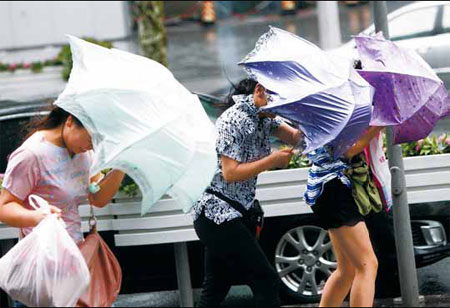
Typhoon Haikui battered the country's coastal areas with strong winds and floods on Wednesday, killing at least one person, and is expected to linger in East China through Friday.
China's third typhoon in a week landed in Hepu township, Xiangshan county in Zhejiang province, at 3:20 am, causing widespread flooding and landslides, paralyzing traffic and triggering blackouts throughout the area.
In Nanjing, capital of East China's Jiangsu province, a 68-year-old cyclist was crushed by a tree leveled by strong winds from Haikui. The man died later in a hospital, China News Services reported on Wednesday.
China's National Meteorological Center said Haikui, which means "sea anemone", lessened to a strong storm on Wednesday afternoon, packing winds of up to 108 kilometers per hour. It would move northwest at a speed of 15 km/h, with its center expected to enter East China's Anhui province on Wednesday night, the center said.
It will linger near the border area of Anhui, Jiangsu and Zhejiang on Thursday and Friday, as its strength slowly ebbs, the center said.
"Haikui moved very slowly on land because of the lack of a strong air current to lead it more quickly, and it is located in a weak meteorological area between continental high pressure and the secondary high pressure on the sea," Shanghai Meteorological Bureau's chief meteorologist, Man Liping, said on Wednesday.
In Shanghai, the meteorological department raised the typhoon alarm to red, the highest level, at 11:30 am on Wednesday. The entire city was subject to the storm's wrath, with maximum rainfall in areas close to 130 millimeters.
Many companies closed for the day, and hundreds of thousands of residents living on the city's outskirts were evacuated. Haikui's impact on Shanghai was expected to subside slightly between Wednesday night and early Thursday.
As of 2 pm Wednesday, a total of 700 flights had been canceled at Shanghai's two major airports.
On the ground, Haikui paralyzed hundreds of long-distance bus services that were scheduled to depart from Shanghai to nearby regions. At Shanghai South Long-Distance Bus Station alone, more than 600 bus runs were called off, representing almost 60 percent of its services.
Shanghai railway authorities said on Wednesday that it has suspended all high-speed railway services linking the city with Nanjing and Hangzhou, and some of the services to Beijing. Haikui also delayed almost all other trains, including the one from Beijing to Hangzhou carrying Olympic gold medal swimmers Sun Yang and Ye Shiwen.
It also paralyzed the city's magnetic levitation line and part of the service on Metro Line 2. It was the first time these lines were suspended because of a storm.
The strong wind ripped open the scaffold on top of the Shanghai Tower, which will be China's tallest building upon completion. Police evacuated the area on the ground. The alarm was lifted after the structure was reinforced.
The city's flood control department said on Wednesday afternoon that the city's inundation threat was under control and the city was operating normally.
In nearby Zhejiang, Haikui caused widespread flooding and traffic interruption as its center moved past densely populated Shaoxing, Hangzhou and Huzhou.
According to the Office of Zhejiang Flood Control and Drought Relief Headquarters, more than 3.2 million residents in Zhejiang were affected by Haikui by noon on Wednesday. A total of 2,900 houses were flattened, and 30,000 businesses suspended production. About 220 roads and 770 electric lines were affected. The direct economic loss stood at about 6.8 billion yuan ($1.07 billion).
Qinshan Nuclear Power Station in Zhejiang's Haiyan county reduced its electricity generation on Wednesday but returned to normal later when the typhoon's threat subsided.
At least 18 villages and townships in Zhejiang suffered blackouts on Wednesday, affecting more than 80,000 residents.
"The electrical power and water supply were cut on Tuesday evening," said Zhu Jiaqi, a self-employed resident of Ningbo. "It was very difficult to walk outside because the road was filled with puddles from the heavy rain."
In Hangzhou, more than 180 trees were uprooted by the strong wind.
"Trees along the West Lake were flattened," said 22-year-old Lai Gaoyue in Hangzhou. "No memo was issued yesterday to tell us to stay at home, but most of my colleagues chose to take the day off. The boss told us to leave after lunch. It is very hard to get a taxi."
Floods triggered by Haikui also trapped 44 Shanghai tourists in a remote village in Zhejiang's Pan'an county on Wednesday.
An SOS message on a micro blog at about 9 am on Wednesday said the group was stranded in a four-story building at the riverside, and their lives were in danger because the building's lower part was undermined by floods.
They were later relocated to the houses of local residents with ample food and water supply.
Contact the writers at wangzhenghua@chinadaily.com.cn and lixinzhu@chinadaily.com.cn