Grads should take blue-collar work
|
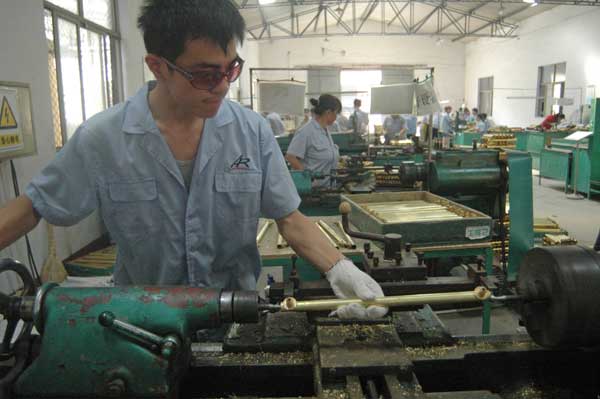
Meng Jirui, a student at Liaocheng University, processes a copper pipe at an automobile parts factory in Liaocheng, Shandong province, recently. The university recommended 80 students to work at local factories for two months during the summer vacation. Zhang Zhenxiang / for China Daily |
Zhu Yuewei was relieved to find a job at a car factory two months after graduating from college last year.
The 24-year-old, who majored in mechanical engineering, was uneasy looking for work because he was one of only a few students in his class not employed after graduation.
"I wanted to work in a big company and do a decent job, like some of my classmates did," said Zhu, who works in the factory's product testing department. "But I was not that lucky."
After graduating from college in Sichuan province, he returned to his hometown, Chongqing, in August.
He decided to lower his expectations and took a job as a technician.
"What I learned in school is not related to my work, but I'm a quick learner and I gradually got used to the work," he said. "Several division chiefs in my company used to be technicians, so maybe through hard work I'll have a chance to get promoted someday," he said.
Zhu is not alone in believing college graduates should consider taking blue-collar work.
In a recent China Youth Daily poll of 2,008 people, 83 percent supported the idea that unemployed college graduates should take blue-collar jobs. More than 73 percent of respondents were born after 1970.
The employment outlook for graduates is tougher now because 200,000 more graduates are expected to leave college this year. Graduates are having a hard time getting a job, and many businesses have difficulties recruiting workers and technicians, revealing structural problems in the work market, Yin Weimin, minister of human resources and social security, said at a news conference in March.
A survey by the labor authority in Shanghai revealed that as of 2011, among all unemployed residents in the city's urban area, 30 percent were younger than 35 and nearly 20,000 had been unemployed for more than a year.
Liu Qingrui, an official at the employment promotion center at Northeastern University in Shenyang, Liaoning province, said his school encourages graduates who have difficulty finding work to take a blue-collar job.
"Many students have the idea that they have to find a job at a well-known company or at least take white-collar work," he said, "But some do not realize that they may not be qualified and there are insufficient vacancies for such work."
Liu suggested that graduates who cannot find their ideal job should lower their expectations so they can accumulate working experience, then they can choose what they want to do in the future.
Liu said that because many businesses are shifting from traditional, labor-intensive manufacturing to more high-tech production, there is huge demand for technicians.
"Grassroots jobs are essential for graduates because they can pave the way for higher positions in research and development or management," he said.
Eighty-one percent of respondents in the China Youth Daily survey said unemployed college graduates would rather stay unemployed than take a blue-collar job because blue-collar workers have a comparatively low social status and the work is difficult.
Chen Yu, director of the China Institute for Occupation Research at Peking University, said blue-collar workers on assembly lines in the United States might earn more than white-collar workers but in China their pay is still low.
"China should gradually raise workers' pay, especially technicians, who are in great demand, to attract more young people to blue-collar work," he said.
Chen also suggested that the surplus of college graduates and shortage of technicians shows that the country needs to adjust its education structure to better match market demand.
Contact the writer at chenxin1@chinadaily.com.cn.