Gender imbalance set to ease
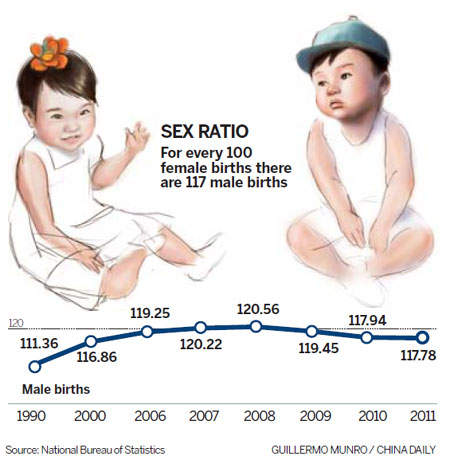
The skewed birth sex ratio, with more than 117 males for every 100 females, is targeted to drop to below 115 by 2015, a senior population official said.
The ratio stands at exactly 117.78 males born for every 100 females, official statistics showed. It peaked in 2008 at 120.56.
"Despite a decline over the last three years, the situation, compared to the 'normal ratio' of 103 to 107, is still severe and government-led intervention is necessary," Zhang Jian, publicity chief of the National Population and Family Planning Commission, said.
"It will be a tough task to meet the 2015 goal and an intense effort is needed," he told China Daily on Thursday.
Last August, the commission and other government agencies, including the Ministry of Health and the Ministry of Public Security, launched a national campaign to curb non-medical sex determination and sex-selective abortions.
"We'll extend that campaign into this year," Zhang said.
Zhai Zhenwu, head of the social and population college at the Beijing-based Renmin University, said there was a deeply rooted tradition of preferring male births.
As fertility rates declined due to the family planning policy, the figure for male births surged ahead, he said.
The increasing availability of ultrasound technology, enabling fetus gender testing on the mainland in the 1980s, made sex selection easier and led directly to an increasingly imbalanced gender ratio, he explained.
And "it's easy to access such tools, particularly at the grassroots," he added.
"Campaigns will help stop sex-selective abortions and address the 'marriage squeeze,' which is expected," he said.
It is estimated that by 2020, China will have 24 million more men than women of marriageable age on the mainland.
"It is not only a population problem, but also a grave social problem as many men will fail to find a wife," Zhang said.
"Such a man may face an old age without the economic and emotional support of a wife and children," Zhai noted.
The provinces of Jiangxi, Hainan, and Guangdong now suffer the most skewed birth sex ratio, he said.
Authorities in Jiangxi province last year uncovered 2,064 cases of non-medical gender testing and sex-selective abortions.
They revoked the licenses of 312 medical workers and detained and sentenced 83 people.
"In places like Guangdong, despite its rising economic clout, people there still prefer boys to girls," Zhai said.
"That boy-preference norm will be reversed as people become more urbanized," he said.
In cities such as Beijing and Shanghai, the birth sex ratio is normal for residents who have a hukou, or residence permit, official statistics showed.
"However, it is imbalanced among migrant workers," Zhai pointed out.
He urged the government to target efforts particularly at rural areas and the migrant population in cities.
In addition to campaigns to end sex selection, the commission is also working closely on raising public awareness and implementing policies favoring families with a girl, particularly in the countryside, Zhang said.
shanjuan@chinadaily.com.cn
(China Daily 03/30/2012 page1)