Measures to improve air quality given more impetus
|
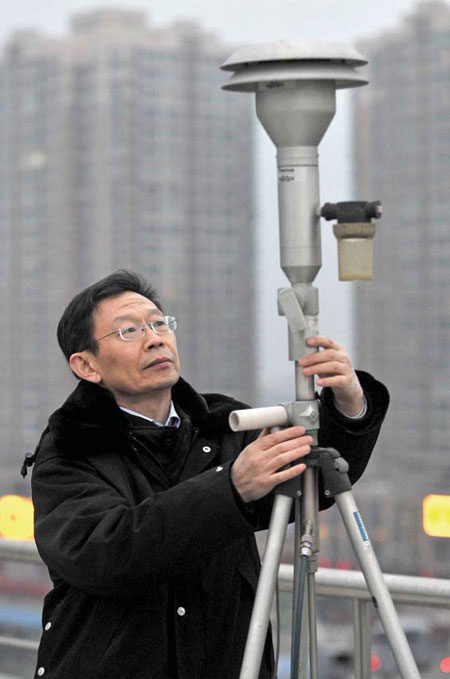
A staff member of the Beijing Municipal Environmental Monitoring Center readjusts the surveillance equpiment for measuring PM 2.5 pollutants. More than 30 PM 2.5 pollutant monitoring stations will be set up in Beijing by the end of this year. Provided to China Daily |
New steps may reduce fine-particle pollution in major chinese cities
Three and a half years after the Olympic Games in Beijing, the city is ramping up its fight against air pollution.
Liu Qi, Party secretary and the top official of Beijing, said this week that 6 billion yuan ($952 million, 718 million euros) would be spent this year to plant 13,300 hectares of trees, which in theory would cover 12 percent of the city's land area.
The main goal is to reduce the content of PM 2.5 (particulate matter smaller than 2.5 micrometers in diameter), which can trigger cardiovascular and respiratory diseases, as well as lung cancer.
Since last year extremely high PM 2.5 readings by the US embassy in the Chaoyang district of Beijing have raised public alarm about air quality.
Since October many cities in China, including Beijing and Shanghai, have had extended bouts of heavy smog.
As fears about such pollution have surged nationwide, sales of products such as air purifiers and masks have done likewise.
"The pollution is especially severe during the heating season in the capital," said Wang Yu, 26, a Beijing resident, referring to when central heating is supplied to most homes, between mid-November and mid-March.
"I feel more at ease with a mask to filter out the smog."
In response to public unease over hazy days and the smell of coal in the air, the Ministry of Environmental Protection started gauging public opinion on revised air quality standards in November.
In 21 days, the ministry said, it received more than 1,500 letters, e-mails and faxes from people expressing concerns about air quality and calling for more stringent standards.
Dong Liangjie, a former environmental scientist at the University of Hawaii, said particulate matter pollutants can cause a range of health problems, primarily cardiovascular and respiratory, including impaired lung capacity, shortness of breath and coughing.
"Those older than 65, children, pregnant women and those suffering asthma and cardiovascular diseases are especially vulnerable."
Under the stricter standards, to be adopted nationally by 2016, the readings of concentrations less than PM 2.5 will be included in measurements.
There will be an average annual ceiling of 35 micrograms a cubic meter, and a daily limit of 75 micrograms a cubic meter, in line with the lowest level of World Health Organization recommendations.
In addition, rules on pollutants already being monitored, including nitrogen oxides, sulfur dioxide and PM 10, will be tightened, and the country's existing air pollution index will be broadened to take into account ozone and carbon monoxide pollution levels.
Cities in the Beijing-Tianjin-Hebei region, Yangtze River Delta and Pearl River Delta, as well as Southwest China's Chongqing municipality and provincial capitals are required to monitor PM 2.5 and ozone starting this year, said the Minister of Environmental Protection, Zhou Shengxian.
Bad smog is also putting pressure on governments to accelerate pollution abatement programs. Cities including Beijing, Shanghai and Guangzhou have stepped up air pollution control measures, including setting up fine-particulate-matter monitoring stations, and have begun to put more effort into training inspectors.
In Beijing, more than 30 PM 2.5 pollutant monitoring stations will be set up based on the city's existing facilities by the end of this year, to inform the public about air quality, said the Beijing Municipal Environmental Protection Bureau on Feb 1.
"The city will carefully select the locations of the stations, which will be set up in all the 16 districts and counties in the city," said Yu Jianhua, director of the air pollution control division of the bureau
A recent Beijing government report said that this year reducing fine particle pollution was the main priority, ahead of housing, health, and education.
Ma Jun, director of the Institute of Public and Environmental Affairs, said that while emissions from industrial sources contribute most to PM 2.5 nationwide, vehicle emissions play a significant role in contributing to the particulate pollutants in urban areas.
"The number of (Beijing's) vehicles has soared to 5 million, and automobiles are definitely the major source of PM 2.5 in the city," said Du Shaozhong, before he resigned from the post of deputy director and spokesman for the city's environmental protection bureau early last month.
Du said the city is determined to scrap another 10,000 cars that produce heavy emissions out of the 5 million total in the city, and the city's fuel emission standards will be tightened.
According to data provided by the capital's environmental protection bureau, the density of PM 2.5 and of PM 10 have both fallen over the past decade, with the average annual PM 2.5 density in Beijing falling from 100-110 micrograms a cubic meter of air in 2000 to 70-80 micrograms a cubic meter in 2010.
The city aims to cut the concentration down to 60 micrograms a cubic meter in 2015 and 50 micrograms in 2020.
Du said improving a city's air quality is difficult and takes a long time.
"We've learned over the decades that once the environment is damaged, it takes great effort to repair," said Wang Qiuxia, a researcher with the Green Beagle, a non-governmental environmental protection organization in the capital.
"Even in European countries it takes several decades to improve the air, and the same applies to a developing country such as China."
Fang Li, deputy director of the capital's environmental protection bureau, said: "Reducing the concentration of pollutants, especially for developing countries such as China, takes time. We should solve problems appearing due to rapid development."
Du said that fighting pollution is a regional effort. The bureau says that 24.5 percent of the PM 2.5 pollutants are from neighboring provinces.
"Air pollution control is not an issue for Beijing alone," Du said. "It is important we make joint efforts with surrounding provinces.
"Apart from the government's efforts, the public should get involved by driving less and taking public transport. It's a hard road, but we'll stick to it."
(China Daily 02/24/2012 page3)