Golf course designer tests the water
|
Golf course designer Tim Lovell says golf shouldn't just be a rich man's game. He would like to create more affordable courses. Provided to China Daily |
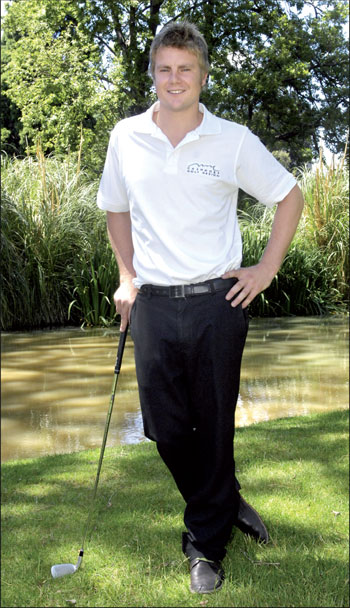
For australian Tim Lovell, 'It's in the water' has added meaning to what he is doing
Tim Lovell is creating paths less traveled on golf courses in China. As a course designer he pays attention to water recycling, comes up with small, affordable courses, some with just three holes, and works hard to preserve the natural landscape.
Lovell, 28, an Australian, is a relative fledgling in the world of golf course design, the galleries of which are stacked with former pros who have worked in the field for 20 to 30 years.
But his experience in playing golf for more than 10 years and working on golf courses since he was a young boy has given him the know-how to be able to design courses, he says. As a youngster, his duties included mowing greens and fairways, raking bunkers and repairing irrigation systems.
"In Australia, many young golf enthusiasts like myself would actively seek part-time work as members of golf course maintenance crews during our school and university holidays. It gives you a real understanding about how to maintain a golf course and how to present a course for tournament play."
Lovell now works with Cashmore Golf Design. One of his areas of expertise is construction supervision. He has just finished overseeing the building of a course in Foshan, in South China's Guangdong province.
Cashmore Golf Design operates in Australia and Asia, which means Lovell is a frequent flyer. The rules of golf landscape design are pretty much universal, but policies and regulations differ widely from country to country, he says.
Recently the Chinese government made it clear that it is unhappy with the amount of golf courses being built, and the fact that they waste water.
"This is not true," Lovell says. "This may have been the case previously, but with modern water-saving techniques, golf can be played and precious water resources can be preserved.
"Don't forget, Australia is the driest continent on earth and Australians know about water and how to save it."
There are 15,000 courses in the United States, but only between 300 to 500 in China, he says.
Many of Lovell's projects in Australia involve harvesting water on the golf course, treating it on-site and providing residences and others nearby with the precious resource.
"We can collect the water seeped into the soil and recycle it to the lake. And by growing strong and drought-resistance seeds, water can also be saved," Lovell says.
He acknowledged that early and strong commitment from local governments and golf course developers is imperative.
The annual report of the golf industry by Forward Group, a golf course management company in China, indicates that the average use of water for an 18-hole golf course is 276,000 tons a year, but this varies from place to place. In dry places, water use can reach 500,000 tons. But in the South, where rain is abundant, it is less than 150,000 tons.
"In southern China, rather than there being a lack of water, there is so much that draining it off is a headache," says Wu Ruocheng, a former director of Forward Group.
Whatever the government's concerns are on water, the golf builders of China are pressing on with their work - even if it is a little more quietly.
Bill Yang, a Canadian golf course designer who has been working in the field for more than 25 years, agrees with Lovell, and adds that if the local landscape is properly designed, a course can even get by without grass.
He cites a course that operates in northern Canada where the weather is freezing and no plants grow. "We soak some sand in oil, so it looks black from a distance, which creates the illusion of greens.
"You should preserve the natural landscape as much as possible and make full use of it, so it has the natural beauty and a distinct feeling when playing."
Lovell, as a member of a design team and as a construction supervisor, believes the key to developing golf courses is to establish absolute trust between client and designer.
Issues he discusses with clients include water flow, landscaping near the clubhouse, roads, topography so that golfers do not feel they are always walking uphill and the use of trees.
When Lovell came to China several years ago, what struck him was that many courses are set up exclusively for the rich. Some have 36 holes, and a course can easily cost more than 100 million yuan ($15.68 million, 11 million euros) to build.
"That's fine for the rich to enjoy some special treatment. But in our view, the game of golf should be more democratic in its appeal. The seductive power of the game should be shared by the many, not only by the few."
He cited his boss, Tony Cashmore, saying that what is needed in China is a range of golf courses to suit the many different types who play, or who want to play, the game, especially since it has become an Olympic sport again.
His idea is that a visionary developer or local government should build good public or semipublic golf courses with relatively low fees for daily play by anybody.
"Small or short golf courses are wonderful. Be it a three-hole course, a nine-hole course, or a 12-hole course, the combinations are endless. And they add a whole new dimension to the game, making them especially attractive to those who are time poor in today's fast-paced world."
Lovell said these courses often do not sit well with golfing purist, but they are built with a particular aim in mind and they provide fun for many. Taking up less space, they are cheaper to build and, if designed thoughtfully, they provide a challenge to all types of golfers.
The course that Lovell recently finished in Foshan has nine holes, a rarity in China, where investors love the extended courses of 27 holes or 36 holes.
"Such an idea is ideal for China, where land is at a premium, where costs may need to be kept in check, where revenue and tourism may be important and where golf is becoming very popular."
Lovell says that Australia has only 23 million people, but virtually every little town, even in very remote areas, has its own little golf course and people of all ages regularly play the game and have cheap fun.
His idea is echoed by his counterpart Yang. After designing countless courses across the world, he says he wants to move to small and cheap courses designated for the young.
"Tomorrow, I will begin to act to help the youth," Yang says. "I hope the government can offer rebates to build small courses. It doesn't have to be extravagant club houses, but small and simple ones for kids, where (soft drinks) and snacks are sold."