


Trade winds with EU blow cold
Exporters may face internal pressures due to monetary policy tightening
|
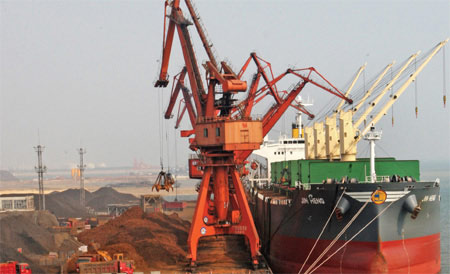 Iron ore being unloaded at the Qinzhou port in Guangxi. China's trade surplus declined 18 percent to $44.9 billion during the first six months of the year. [Liang Fuying / for China Daily] |
Bilateral trade between China and the European Union (EU) will see slower growth in the second half of the year due to the ongoing debt crisis in Europe and monetary tightening in China, economists say.
Sino-EU trade grew by 21.2 percent during the first six months of the year to $265.9 billion (188.3 billion euros), compared with a 37.2 percent growth during the same period last year, according to Customs data.
"During the second half of this year, China's exports to the EU will grow at a slower pace as the euro zone's recovery from the debt crisis will remain weak and fragile. There will be intense pressure on the domestic exporters due to the monetary policy tightening," says Song Hong, director of International Trade Section of the Institute of World Economics & Politics at Chinese Academy of Social Sciences.
Zheng Yuesheng, head of the statistics department of China Customs, had in recent remarks already indicated that uncertainties in the global economy would pose big challenges to exports from China.
"The slow recovery of the EU countries, the high unemployment rate, low consumption confidence and the European debt crisis have added uncertainties to export growth," says Zheng.
Zhong Shan, vice-minister of commerce, feels that imports will also slow down during the second half due to the measures taken by the government to cool the overheated economy.
China's exports to the EU surged 16.9 percent to $164.5 billion, while imports from the EU rose 29.1 percent year-on-year to $101.4 billion, according to Customs figures.
The growth rates were much lower than that of the year-ago period - 36 percent for exports and 39.4 percent for imports.
"Import growth was weaker than expected, as imports for China's processing trade weakened and de-stocking in heavy industry continued," says Wang Tao, head of China Economic Research at UBS Securities.
However, some experts find the current situation not bleak at all.
"People will think the growth rate is slower than the same period last year. But we must remember that imports and exports between China and the EU have seen a significant slowdown since 2009," says Song.
"This growth rate is actually better than the expectations of many experts, as the rapid growth recorded in 2010 was largely based on the negative growth in 2009," he says.
Bilateral trade between China and the EU fell by 14.5 percent to $364.09 billion in 2009.
Xiong Hou, deputy chief of the department of economic studies of the Institute of European Studies under the Chinese Academy of Social Sciences, too agrees with Song.
"I don't think we should regard this year's import and export growth rate as too low. Trade between China and the EU is witnessing a recovery in which both the sides are adapting to better deal with their own problems," says Xiong.
However, he warns that Chinese exporters should pay closer attention to the situation if exports continue to slow down.
One negative sign for China's exports to the EU, according to Xiong, is the slow pace of recovery in Germany and France.
"They (Germany and France) are the two most important export destinations for China and also account for a major share of export earnings. A slow recovery in these regions will lead to a negative impact on China's exports to the EU in the subsequent six-month period," he says.
Xiong feels that the situation could improve next year, when the EU, as predicted by the EU Commission, recovers from its debt and financial crisis.
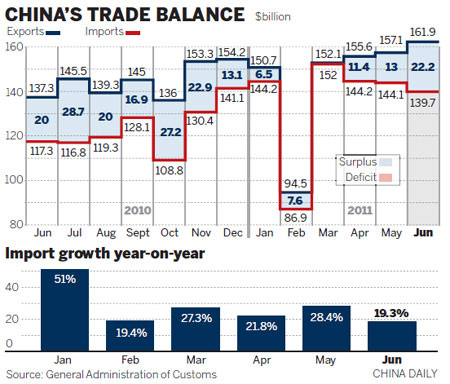
China's overall imports in June rose 19.3 percent from a year earlier to $139.7 billion, the weakest since November 2009, due to the impact of the monetary policy tightening. Exports rose 17.9 percent to a record high of $161.9 billion.
The decline in import growth has also led to a widening trade surplus of $22.3 billion in June compared with $13.1 billion in May. During the first six months of the year the trade surplus declined 18 percent year-on-year to $44.9 billion.
















