-
News >World

Fish or frankenfish? FDA weighs altered salmon
2010-09-21 09:35WASHINGTON - Genetically engineered salmon that grows twice as fast as the conventional fish appears to be safe, an advisory committee told the Food and Drug Administration Monday. They argued, however, that more testing may be needed before it is served on US dinner tables.
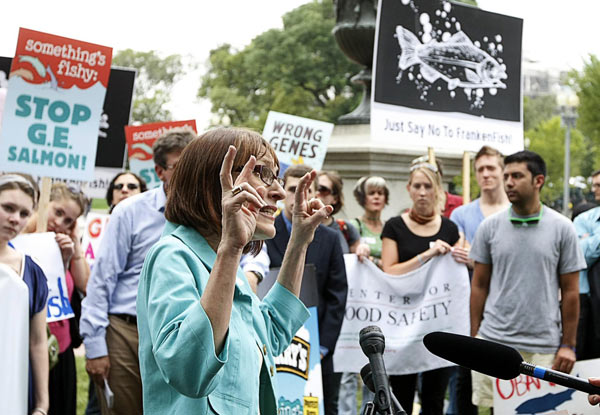
Food and Water Watch Executive Director Wenonah Hauter addresses a rally held to call on the Obama administration "to halt the pending approval of the first genetically modified animal for human consumption", outside the White House in Washington, September 16, 2010. The first genetically modified animal could move one step closer to the US market on September 20, when a federal advisory panel makes its recommendation on whether such food -- a salmon -- is safe for consumers to eat. [Agencies]If the FDA were to approve sale of the salmon, it would be the first time the government allows such modified animals to be marketed for human consumption. The panel was convened by the agency to look at the science of the fish and make recommendations on its safety and environmental impact.
Ron Stotish, chief executive of the Massachusetts company that created the salmon, AquaBounty, said at Monday's hearing that his company's fish product is safe and environmentally sustainable.
FDA officials largely have agreed with him, saying that the salmon, which grows twice as fast as its conventional "sisters," is as safe to eat as the traditional variety. But they have not yet decided whether to approve the request.
Critics call the modified salmon a "frankenfish" that could cause allergies in humans and the eventual decimation of the wild salmon population. Representatives from consumer, environmental and food safety groups asked the agency to reject the company's application to market the fish, saying it is untested.
The advisory committee agreed with the FDA that the company has presented compelling evidence that the fish is safe. Members noted several misgivings about the data, saying many of the sample sizes were too small and how healthy the fish will be after many years of breeding.
It is still unclear whether the public will have an appetite for the fish if its marketing were to be approved. Genetic engineering already is widely used for crops, but the government until now has not considered allowing the consumption of modified animals. Although the potential benefits, and profits, are huge, many people have qualms about manipulating the genetic code of other living creatures.
Part of the hearing focuses on labeling of the fish. It is possible that if the modified salmon were to be approved, consumers would not even know they were eating it. Current FDA regulations require modified foods to be labeled as such only if the food is substantially different from the conventional version, and the agency has said that the modified salmon is essentially the same as the Atlantic salmon.
If approved, the fish could be in grocery stores in two years, the company estimates.
Approval would open the door for a variety of other genetically engineered animals, including a pig that is being developed in Canada or cattle that are resistant to mad cow disease. Each would have to be individually approved by the FDA.
"For future applications out there, the sky's the limit," said David Edwards of the Biotechnology Industry Association. "If you can imagine it, scientists can try to do it."
AquaBounty says it would be the first in the world to market genetically engineered fish. The company submitted its first application for FDA approval in 1995, but the agency did not decide until two years ago to consider applications for genetically engineered animals, which was seen as a breakthrough by the biotechnology industry.
Genetically engineered, or GE, animals are not clones, which the FDA already has said are safe to eat. Clones are copies of an animal. In GE animals, the DNA has been altered to produce a desirable characteristic.
In the case of the salmon, AquaBounty has added a growth hormone from a Chinook salmon that allows the fish to produce growth hormone all year long. The engineers were able to keep the hormone active by using another gene from an eel-like fish called an ocean pout that acts like an on switch for the hormone, according to the company. Conventional salmon produce the growth hormone only some of the time.
In documents released ahead of the hearing, the FDA said there were no biologically relevant differences between the engineered salmon and conventional salmon, and there is a reasonable certainty of no harm from its consumption. FDA scientists said Monday very few differences exist between the modified and conventional fish.
Critics have two main concerns: The safety of the food to humans, and the salmon's effect on the environment.
Because the altered fish has never been eaten before, they say, it could include dangerous allergens, especially because seafood is highly allergenic. They also worry that the fish will escape and intermingle with the wild salmon population, which is already endangered. They would grow fast and consume more food to the detriment of the conventional wild salmon, the critics fear.
The FDA tried to allay both of those worries Monday, saying the fish should not cause any allergies not already found in conventional salmon, and that there is little chance they could escape.
Critics speaking at the meeting said they were concerned about the unintended consequences of approval, arguing the FDA is relying on too little data.
Wenonah Hauter, director of the advocacy group Food & Water Watch, said the FDA process is inadequate because it allows the company to keep some proprietary information private. Modified foods are regulated under the same process used for animal drugs.
"With all due respect, we don't believe a veterinary advisory committee is the appropriate place to discuss these food safety issues," Hauter told the panel.
European nations have been much more cautious in embracing engineered foods. Ruediger Rosenthal, a spokesman for Bund-Friends of the Earth Germany, said it is unlikely the modified fish would make it across the Atlantic for sale as many Europeans are very skeptical of genetically modified foods.
AquaBounty CEO Stotish countered his product has come under more scrutiny than most food.
"This is perhaps the most studied fish in history," he said. "Environmentally this is a very sustainable technology."
The company has several safeguards in place to quell concerns. The fish would be bred female and sterile, though a small percentage might be able to breed. They would be bred in confined pools where the potential for escape would be low.
In its environmental analysis of the fish released this month, the FDA agreed with the company that there are enough safeguards in place.
Stotish says the fish would be bred in better conditions than many of the world's farmed salmon and could be located closer to towns and cities to help feed more people. The company also has said the increase in engineered salmon production could help relieve endangered wild salmon populations.
The company is also arguing that the fish do not need to be labeled as genetically engineered. Stotish said, "The label could even be misleading because it implies a difference that doesn't exist."