-
News >World

Key oil spill evidence raised to Gulf's surface
2010-09-06 10:19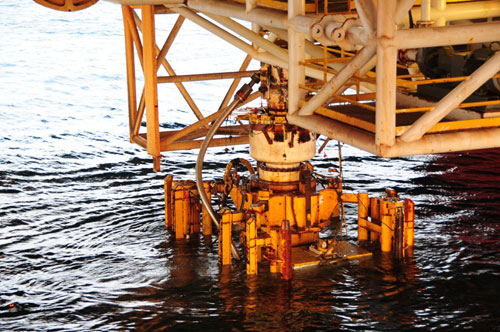
The damaged blowout preventer from the Deepwater Horizon oil rig is extracted by the Q4000 vessel from the Gulf of Mexico in this handout photograph taken on September 4, 2010 and released on September 5. [Photo/Agencies]ON THE GULF OF MEXICO - Investigators looking into what went wrong in the Gulf of Mexico oil spill are a step closer to answers now that a key piece of evidence is secure aboard a boat.
Engineers took 29 hours to lift the 50-foot (15.24-meter), 300-ton blowout preventer from a mile (1.6 kilometer) beneath the sea, and the five-story-high device looked largely intact Saturday night with black stains on the yellow metal.
FBI agents were among the 137 people aboard the Helix Q4000 vessel, taking photos and video of the device. They will escort it back to a NASA facility in Louisiana for analysis.The blowout preventer was placed into a metal contraption specifically designed to hold the massive device at 9:16 pm CDT Saturday (0216 GMT Sunday). As it was maneuvered into place, crew members were silent and water dripped off the device.
Crews had been delayed raising the device after icelike crystals, called hydrates formed on it. The device couldn't be safely lifted from the water until the hydrates melted because the hydrates are combustible, said Darin Hilton, the captain of the Helix Q4000.
Hydrates form when gases such as methane mix with water under high pressure and cold temperatures. The crystals caused BP PLC problems in May, when hydrates formed on a 100-ton, four-story dome the company tried to place over the leak to contain it.
As a large hatch opened up on the Helix to allow the blowout preventer to pass through, several hundred feet (meters) of light sheen could be seen near the boat, though crews weren't exactly sure what it was.
The April 20 explosion aboard the Deepwater Horizon killed 11 workers and led to 206 million gallons (780 million liters) of oil spewing from BP PLC's undersea well.
Investigators know the explosion was triggered by a bubble of methane gas that escaped from the well and shot up the drill column, expanding quickly as it burst through several seals and barriers before igniting.
But they don't know exactly how or why the gas escaped. And they don't know why the blowout preventer didn't seal the well pipe at the sea bottom after the eruption, as it was supposed to. While the device didn't close, or may have closed partially, investigative hearings have produced no clear picture of why it didn't plug the well.
Documents emerged showing that a part of the device had a hydraulic leak, which would have reduced its effectiveness, and that a passive "deadman" trigger had a low, perhaps even dead, battery.
Steve Newman, president of rig owner Transocean, told lawmakers following the disaster that there was no evidence the device itself failed and suggested debris might have been forced into it by the surging gas.
There has also been testimony that the blowout preventer didn't undergo a rigorous recertification process in 2005 as required by federal regulators.
Recertifying the five-story device requires completely disassembling it out of the water and can take as long as three months to complete.
Testimony from BP and Transocean officials also showed that repairs were not always authorized by the manufacturer, Cameron International, and that confusion about the equipment delayed attempts to close the well in the days after the explosion.
A Transocean official has said he knew the blowout preventer was functioning because he personally oversaw its maintenance, and he said the device underwent tests to ensure it was working. The device, he said, had undergone a maintenance overhaul in February as it was being moved to the Deepwater Horizon to be placed over BP's well.
Also, according to testimony, a BP well site leader performed a pressure test April 9 on the blowout preventer, and he said it passed.
George Hirasaki, a Rice University engineering professor, said the blowout preventer should have sheared through the drill pipe and shut off the flow of oil. There may have been two sections of drill pipe or a thicker section, called the "collar," that the blowout preventer could not shear through, he said.
He also said the device's hardware was changed, but the on-site drawings were not updated to reflect the changes. Investigators will be looking for any other discrepancies between the device and its drawings.
In short, Hirasaki said, "The BOP failed to do its function. It is important to determine why so that it does not occur again."
However, some have cautioned that the blowout preventer will not provide clues to what caused the gas bubble. And it is possible a thorough review may not be able to show why it didn't work.
That could leave investigators to speculate on causes using data, records and testimony.
Lawyers will be watching closely, too, as hundreds of lawsuits have been filed over the oil spill. Future liabilities faced by a number of corporations could be riding on what the analysis of the blowout preventer shows.
A temporary cap that stopped oil from gushing into the Gulf in mid-July was removed Thursday. No more oil was expected to leak into the sea, but crews were standing by with collection vessels just in case.
The government said a new blowout preventer was placed on the blown-out well late Friday. Officials wanted to replace the failed blowout preventer first to deal with any pressure that is caused when a relief well BP has been drilling intersects the blown-out well.
Once that intersection occurs sometime in September, BP is expected to use mud and cement to plug the blown-out well for good from the bottom.