-
News >World

BP affixes new cap on Gulf oil well; tests ahead
2010-07-13 09:46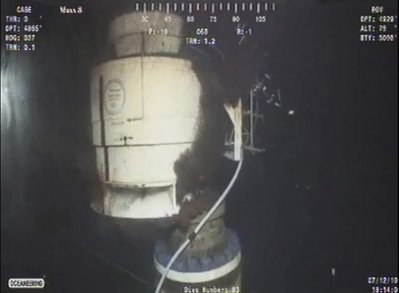
In this image taken from video provided by BP PLC at 18:14 CDT, a new containment cap, left, is lowered over the broken wellhead at the site of the Deepwater Horizon oil spill in the Gulf of Mexico, Monday, July 12, 2010. [Agencies]?
NEW ORLEANS – BP robots attached a new, tighter-fitting cap on top of the gushing Gulf of Mexico oil leak Monday, raising hopes that the crude could be kept from polluting the water for the first time in nearly three months.
Placing the cap on top of the leak was the climax of two days of delicate preparation work and a day of slowly lowering it into position a mile below the sea. The capping project — akin to building an underwater Lego tower — is just a temporary fix, but the oil giant's best hope for containing the spill.
The next unknown is whether the 18-foot-high, 150,000-pound metal stack of pipes and valves will work. BP plans to start tests Tuesday, gradually shutting the valves to see if the oil stops or if it starts leaking from another part of the well.
Residents have been skeptical BP can deliver on its promise to control the spill, but the news was still welcome on the coast. Dwayne Touchet, a 44-year-old shrimper from Welsh, La., said he was relieved to hear the cap was on and can only pray that it works. Touchet is working in the Vessels of Opportunity program, where BP employs local boat owners and fisherman out of work because of the spill."It's not over, there's still a lot of oil to clean up. We don't know how it will affect it (the water) in the years to come, all we can do is trust in the Lord," he said.
Around 6:30 pm CDT, live video streams trained on the wellhead showed the cap being slowly lowered into place, 11 hours after BP Chief Operating Officer Doug Suttles said the company was close to putting the seal in place. BP officials said the device was attached around 7 p.m.
The cap will be tested and monitored to see if it can withstand pressure from oil and gas starting Tuesday morning for six to 48 hours, according to National Incident Commander Thad Allen. On his Facebook page, Allen also shared news of the development. "Getting there," Allen wrote in a status update shortly after the cap landed on the well.
The cap will be tested by closing off three separate valves that fit together snugly like pairs of fists, choking off the oil and blocking it from entering the Gulf.
BP doesn't want the flow of oil to stop instantaneously, said Don Van Nieuwenhuise, director of Professional Geosciences Programs at the University of Houston. Shutting the oil off too quickly could cause another explosion, he said.
"Rather than like a train running into a brick wall, it'll be more like putting the brakes on slowly," he said. "That's what they're aiming for. You can keep the brakes on and everyone arrives alive, or you hit the wall and have big problems."
Engineers will be watching pressure readings. High pressure is good, because it would mean the leak has been contained inside the wellhead machinery. But if readings are lower than expected, that could mean there is another leak elsewhere in the well.
"Another concern right now would be how much pressure the well can take," and whether intense pressure would further damage the well, said Eric Smith, associate director of the Tulane Energy Institute.
Even if the cap works, the blown-out well will still be leaking. But the newer, tighter cap will enable BP to capture all the oil, or help funnel it up to ships on the surface if necessary.
One of those ships, the Helix Producer, began operating Monday and should be up to its capacity of collecting roughly 1 million gallons of oil a day within a few days, Suttles said.
A permanent fix will have to wait until one of two relief wells being drilled reaches the broken well, which will then be plugged up with drilling mud and cement. That may not happen until mid-August.
Meanwhile, the Obama administration issued a revised moratorium on deep-water offshore drilling Monday to replace the one that was struck down by the courts as heavy-handed. The new ban, in effect until Nov. 30, does not appear to deviate much from the original moratorium, as it still targets deep-water drilling operators while defining them in a different way.
Work on the new capping operation began Saturday with the removal of a leaky cap that captured about 1 million of the 1.5 million to 2.5 million gallons of oil the government estimates is spilling from the well every day.
Gulf residents closely watched the operation, knowing the damage already done to the biologically rich Gulf and the coast's two leading industries, fishing and tourism.
"I think we're going to see oil out in the Gulf of Mexico, roaming around, taking shots at us, for the next year, maybe two," said Billy Nungesser, president of Louisiana's oil-stained Plaquemines Parish. "If you told me today no more oil was coming ashore, we've still got a massive cleanup ahead."
BP "can't do much, but they know how to drill wells," dock master Jimmy Beason said at a marina in Orange Beach, Ala. "I think that by the end of the month it will be stopped, and this work with the cap is part of it. I see the light at the end of the tunnel."
As of Monday, the 83rd day of the disaster, between 89 million and 176 million gallons of oil had poured into the Gulf, according to government estimates. The spill started April 20 when the Deepwater Horizon rig, leased by BP from Transocean Ltd, exploded and burned, killing 11 workers. It sank two days later.