-
News >World

Tons of bushmeat smuggled into Paris, study finds
2010-06-21 11:08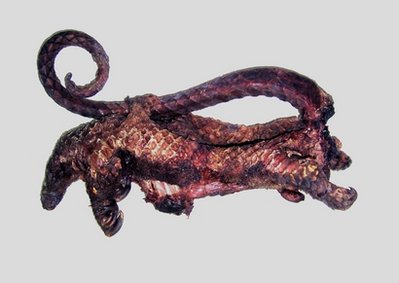
This image released on Thursday June 17, 2010 by the Zoological Society in London and taken in June2008 in France shows a pangolin, which is often referred to as a scaly anteater which was smoked prior to transportation from Africa to France. [Agencies]
PARIS - The traders sell an array of bushmeat: monkey carcasses, smoked anteater, even preserved porcupine.But this isn't a roadside market in Africa -- it's the heart of Paris, where a new study has found more than five tons of bushmeat slips through the city's main airport each week.
Experts suspect similar amounts are arriving in other European hubs as well -- an illegal trade that is raising concerns about diseases ranging from monkeypox to Ebola, and is another twist in the continent's struggle to integrate a growing African immigrant population.The research, the first time experts have documented how much bushmeat is smuggled into any European city, was published Friday in the journal Conservation Letters.
"Anecdotally we know it does happen ... But it is quite surprising the volumes that are coming through," said Marcus Rowcliffe, a research fellow of the Zoological Society of London and one of the study's authors.
In the Chateau Rouge neighborhood in central Paris, bushmeat is on the menu -- at least for those in the know.
Madame Toukine, an African woman in her 50s, said she receives special deliveries of crocodile and other bushmeat each weekend at her green and yellow shop off the Rue des Poissonieres market. She wouldn't give her full name for fear of being arrested.
"Everyone knows bushmeat is sold in the area and they even know where to buy it," said Hassan Kaouti, a local butcher. "But they won't say it's illegal."
For the study, European experts checked 29 Air France flights from Central and West Africa that landed at Paris' Roissy-Charles de Gaulle airport over a 17-day period in June 2008.
Of 134 people searched, nine had bushmeat and 83 had livestock or fish.
The people with bushmeat had the largest amounts: One passenger had 112 pounds (51 kilos) of bushmeat -- and no other luggage. Most of the bushmeat was smoked and arrived as dried carcasses. Some animals were identifiable, though scientists boiled the remains of others and reassembled the skeletons to determine the species.
Experts found 11 types of bushmeat including monkeys, large rats, crocodiles, small antelopes and pangolins, or anteaters. Almost 40 percent were listed on the Convention on International Trade in Endangered Species.
Based on what officials seized -- 414 pounds (188 kilos) of bushmeat -- the researchers estimated that about five tons of bushmeat gets into Paris each week.
They also noted that penalties for importing illegal meats are light and rarely imposed. Under French law, the maximum penalty is confiscation of the goods and a $556 (450 euro) fine. Of the passengers searched in the study, only one person with bushmeat actually was fined.
Bushmeat is widely eaten and sold in Central and West Africa, with Central African Republic, Cameroon and Republic of Congo being the main sources. It varies whether it is legal. It is typically allowed where people are permitted to hunt, as long as their prey aren't endangered and they can prove the animals were killed in the wild.
A bushmeat ban is enforced in Kenya, but it is legal in most parts of the Republic of Congo, where hunters may stalk wildlife parks that aren't heavily guarded. Even after several outbreaks of the deadly Ebola virus linked to eating bushmeat, the practice remains widespread.
Scientists warned eating bushmeat was a potential health hazard.
"If you have intimate contact with a wild animal -- and eating is pretty intimate contact -- then you could be exposed to all kinds of diseases," warned Malcolm Bennett, of Britain's National Centre for Zoonosis Research at the University of Liverpool, who was not linked to the study.
Bennett said bushmeat had a higher risk of bacteria like salmonella and might also be carrying new diseases. The virus that causes AIDS originated in monkeys, and the global 2003 SARS outbreak was traced to a virus in bats and civets.
Nina Marano, chief of the quarantine unit at the US Centers for Disease Control and Prevention, said similar underground markets for bushmeat exist across America.
"We have to be culturally sensitive and recognize this is important for some African communities," she said. "But there are no regulations for the preparation of meat from wildlife to render it safe."
The scale of Europe's illicit bushmeat trade suggests the emergence of a luxury market. Prices can be as high as $18 per pound (30 euros per kilo), double what more mundane supermarket meats cost.
"It's like buying the best cut of organically grown beef," Rowcliffe said, adding that bushmeat like giant rats and porcupine, which he has tasted, has a strong, gamey flavor.