-
News >China

A taxing issue for online shops
2011-07-12 07:08'It will be death'
Yu Kai, 40-year-old boss of an online store based in Wuhan, foresees more than "a short-term hurt". If the government taxed Internet sales, he said, it would kill his business. "It will be the death of almost all Net stores."
Yu's company has sold auto parts on Taobao since Aug 1, 2008, and has racked up more than 100,000 transactions. "But we earned little." His eight employees average 1,500 to 3,000 yuan a month in wages, he said.
"The greatest advantage of online shops is providing customers with lower prices" than bricks-and-mortar stores, he said. To draw traffic, he sells some items below cost. "If we have to pay tax, there will be no profits."
"If Wuhan starts to collect tax," he said, "I would choose to change my ID and register in other cities."
Support first
Lu Benfu, an expert on the Internet economy at the School of Management, Chinese Academy of Sciences, said taxes on Internet sales should be collected at some point, but determining how and when that is done is an art.
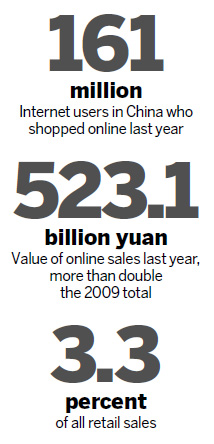
"The government should first of all support the industry for some time before taxing it, which may well be a burden for online sellers." And he thinks exemptions should be allowed under three circumstances: on all online sellers until their number exceeds 5 million; on those whose sales account for less than 5 percent of total retail sales in China; and on those whose average annual income is less than 50,000 yuan.
The government has encouraged people and companies to conduct commerce online, and many experts say e-commerce will stimulate domestic consumption.
Guangdong, Zhejiang and Sichuan provinces, as well as some other areas, have adopted a series of favorable policies for e-commerce, including tax return, rent deductions and free training.
"If the government were to tax online sellers now, it could reduce their passion for taking part in e-commerce business," said Chen Shousong, an analyst with domestic research company Analysys International. He also thinks taxes should be levied differently for goods sold online and traditionally so as not to squelch the motivation of e-sellers.
Xu Xiaolan, deputy director at the China Center for Information Industry Development, said the government could test online taxation in certain cities before putting it into practice nationwide.
VAT elsewhere
Lawyer Liu explained that the VAT system in China has two rates, for large-scale and small-scale shops. The value-added tax for shops with transactions of more than 1.8 million yuan (about $278,000) is 17 percent of the added value (the selling price minus purchase price). For those with lower transaction totals, the tax is 3 percent of the selling price.
In the United Kingdom, Liu said, e-commerce regulations took effect in August 2002. They provide for a standard VAT rate of 17.5 percent, a preferential rate of 5 percent and a rate of zero, depending on the types of products. Stores with less than $92,000 in transactions are not required to pay the tax.
In Germany, the price of products sold online include the VAT. The rate for most products is 19 percent, but for books, it is only 7 percent to encourage people to read more.