-
News >China

New problems for crested ibis
2010-12-22 07:47XI'AN - China's conservation work for the endangered crested ibis is facing new challenges, including an increasing mortality rate due to inbreeding, and the conflict between the need to expand natural habitats and local communities' economic interests, bird experts have warned.
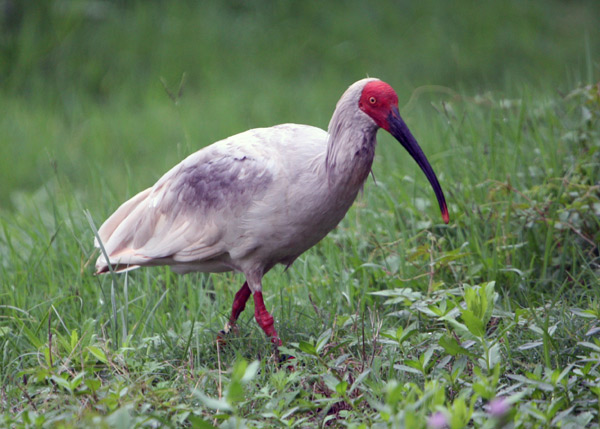
In this file photo a crested ibis wearing a radio tracking device on its foot looks for food. [Liu Dongping / for China Daily]The crested ibis, once widespread in Japan, China, Russia and the Korean Peninsula, almost became extinct in the first half of the 20th century.
Before 1981, when seven crested ibis were accidentally found in Yangxian county, in Northwest China's Shaanxi province, academics thought the species had been extinct in China for almost 17 years.
Due to the huge effort put into species protection since 1981, the number of crested ibis in China has risen to an estimated 1,617, including 997 in the wild, the State Forestry Administration said at a meeting on crested ibis protection in Xi'an on Monday.However, although the ibis population exceeds 1,000, the birds are still not free from the threat of extinction, said Fang Shengguo, director of the State Conservation Center for Gene Resources of Endangered Wildlife at Zhejiang University.
Ornithologists used inbreeding in the early stages of protection so that numbers of the precious birds could increase quickly, but that method had consequences, Fang said.
"Studies have proved that as a result of inbreeding, crested ibis have the lowest genetic diversity of all endangered birds," Fang said.
"It means a high mortality rate and more physical defects for hatched chicks."
The government should collect genetic information from all crested ibis and establish a genetic database as soon as possible, then design a scientific mating plan for the species, Fang said.
So far, about 90 percent of crested ibis live in Shaanxi province, and fewer than 140 ibis live in three zoos in other parts of the country, including Beijing Zoo, according to Liu Dongping, an assistant researcher at the National Bird Banding Center of China, which is affiliated to the Chinese Academy of Forestry.
The bird has lost the ability to migrate, he said, adding that if an unexpected natural disaster occurred in Shaanxi province or an infectious disease spread through the area, the ibis population could be greatly reduced.
Experts also warned that the increased population of ibis, whether in the wild or in captivity, requires a larger and more varied natural habitat.
Rampant hunting, the massive loss of habitat caused by deforestation and the overuse of pesticides, which killed aquatic insects on which the ibis feed, are believed to be the main reasons for the sharp reduction in the ibis population before 1981.
So, in 1983, a State-level natural reserve was set up in Shaanxi province to protect the bird.
But the struggle for living space between human and animal has never stopped, said Lu Baozhong, deputy director of the Shaanxi Crested Ibis Conservation Station.
"For example, ibis often look for loaches in farmers' rice fields. Sometimes their claws trample the rice seedlings. In another case, villagers discovered some land with abundant mineral resources which happened to be a habitat for ibis," said Lu, who has devoted 30 years to ibis protection.
A long-term win-win solution for ibis and local communities needs to be developed, one that would provide ecological compensation for local residents, Lu said.