-
News >China

Property development puts heritage sites at risk
2010-08-18 07:50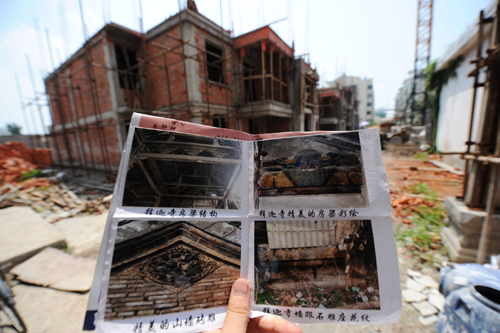
A resident shows pictures of a 900-year-old temple that was demolished to make way for a real estate project in Sixian county of Anhui province on Aug 3. [Xinhua]BEIJING - Many historical relics in China are at risk of being destroyed by the flourishing construction industry.
The third National Cultural Relics Census showed more than 30,000 heritage sites had disappeared by the end of 2009, Beijing News reported on Tuesday.
Sakya Temple at Sixian county in Anhui province, which had a history that stretched back more than 900 years and was listed as a cultural heritage site in 1981, has been demolished to make way for real estate development, according to the report.
It was also reported that the county bureau of land and resources sold the 1.7 hectares on which the temple stood at auction in 2007 for 11.5 million yuan ($1.7 million) after the local government decided to use this State-owned land for development.
"It is ironic that this happened in what is supposed to be a culturally-developed county," said Min Lin, a retired official at the local administration of cultural heritage, in reference to the Ministry of Culture having named Sixian county as "the land of Chinese folk culture and art".
The land was sold without the permission of the administration of cultural heritage. The property developer also carried on with the construction project after having been notified in 2008 that it was a protected site, an insider told Beijing News.
The county government insisted that the temple be rebuilt at a different location, though nothing further has been done in two years.
In early July, 13 granaries that dated back to the Yuan Dynasty (1271-1368) and were nominated as one of 10 most important archeological discoveries of 2009 came under the wrecking ball for business development in Zhenjiang city, East China's Jiangsu province, Xinhua News Agency reported.
Most developers destroy the cultural relics before they receive a notice from the local administration of cultural heritage to avoid costly delays in construction, a real estate industry insider told Xinhua.
"The current environment is harsh for heritage preservation work, because many regional governments continue to give priority to economic development instead of cultural protection," said Guan Qiang, director of the department of cultural heritage conservation at the State Administration of Cultural Heritage.
"However, the preservation of historical relics is not just the work of archaeologists. It needs everyone's participation, including developers, governments and individuals," Guan said.
Lin Liugen, who exposed the destruction of the 13 ancient grain barns, suggested that China needs to consider setting up funding for archaeological work, which could include imposing compensation fees on property developers.