-
News >Bizchina

Indications of a currency war under way?
2010-11-08 11:15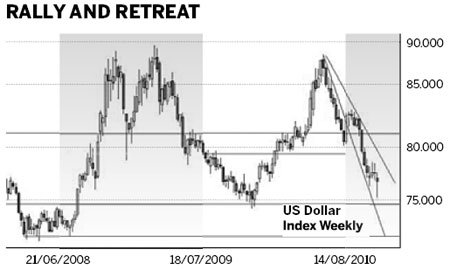
Seigniorage is a very old-fashioned word making a sudden reappearance in the modern world. It follows close on the heels by the confirmation announcement that the second round of quantitative easing in the United States would proceed.

Seigniorage describes the situation where a government makes a profit through the increase in the amount of money in circulation. It happens when the government prints more money and then uses that money to buy its own debt - issued as bonds or treasuries. Then the government pays itself interest on the debt.
Seigniorage became a real issue just under a century ago in Germany during the period between 1919 and 1923. The Weimar government ran large budget deficits to fund the war reparations debt - the same debt that was finally paid off in full less than a month ago. The Weimar government in Germany kept interest rates far below inflation, expanded the money supply rapidly and raised 50 percent of government spending through seigniorage. Increasingly, investors and others fear the US is moving down the same path with an aggressive policy of reducing the value of the US dollar which will lead to domestic inflation.
One of the core problems of the US economic crisis is the mismatch between fiscal value and asset value. Generally there are two ways to bring these two values together. They are through the exchange rate mechanism or through currency debasement. The US is starting the electronic version of the printing presses so people will have cash to pay off the credit binge the US has been on for decades. Printing money on this scale is inflationary, and is potentially hyper-inflationary. This debases the currency.
The US is funding the budget deficit through seigniorage. In the United States, the Federal Reserve (Fed) is buying $75 billion worth of US Treasury bonds a month up to a total of $600 billion. The shift to gold is not just as a protection against a falling US dollar, but it is also an inflation hedge against the consequences of seigniorage.
Without doubt this will re-flate the US economy and the rise in the Dow Jones Industrial Average confirms this, but the cost to other economies may be substantial. The US market has cheered the Treasury plan, but movement in the US dollar index and gold tell a different story as frightened money takes an exit.The first issue is to decide how far the dollar can fall before it finds support. The second question is to identify the barriers the dollar must overcome before it can rise.
The weekly chart of the US Dollar Index against a basket of currencies shows strong historical support is located near $0.745. This marked the low point for the dollar in 2009 October. This support level is the upper edge of a wide trading consolidation band. The lower edge of this band is near $0.715. This low level consolidation was reached between March and August in 2008. A fall below $0.745 has a downside support target near $0.715. In this situation after the fall the strong resistance level is located at the old support level near $0.745. The historical behavior of the Dollar Index suggests a move below $0.745 could lead to several months of rally and retreat behaviour between $0.715 and $0.745.
The Dollar Index has developed a fan pattern. This is defined by an upper and a lower trend line. The lower trend line acts as a support level and allows the dollar to slide down this line towards the next horizontal support level, currently near $0.745. The upper trend line acts as a resistance level with a current value near $0.78. A sustainable rebound in dollar strength is shown only when the Dollar Index is able to move above $0.78 and also break above the historical resistance near $0.795.
The probability of a strong dollar rebound is low and the trend suggests there is a high probability of a fall below $0.745. This consistent dollar weakness will be reflected in other currencies and will support a continued rise in the price of gold. A sustained debasement of the US dollar does not provide a structural solution to the problems of the US economy. The already low dollar has not translated into a significant increase in US exports and domestic demand can only be stimulated by more credit spending. The strong downtrend suggests support at $0.74.5 will not be successful.
Intentionally or not, many see the US Dollar Index chart echoing with the first shot of a currency war.
The author is a well-known international financial technical analysis expert.