-
News >Bizchina

GDP ranking no reason to celebrate
2010-08-06 14:03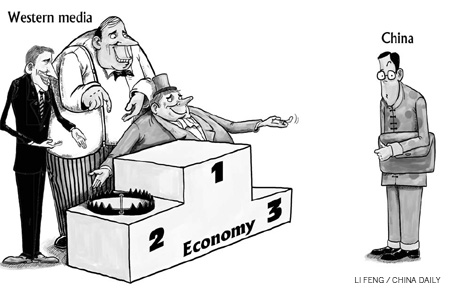
The foreign media are abuzz with the news that China may soon surpass Japan to become the second largest economy in the world.
The source of this excitement is a recent remark by Yi Gang, deputy governor of China's central bank, who said our economy has already overtaken that of Japan's, based on GDP in the second quarter of this year.
This is another milestone in China's economic ascent over the past 30 years. There is really no reason for China to celebrate, however. GDP alone does not give a full picture of the Chinese economy or its place in the world.
According to the World Bank, China's per capita income ranked only 124th in the world last year. On a per capita basis, our GDP is only 10 percent of Japan's.
While the number of Chinese billionaires continues to make news at home and abroad, the gap between the rich and poor and between urban and rural areas continues to threaten China's growth and stability.
Whether it has the second or third largest economy in the world, China faces many challenges, some of which have built up over the past 30 years.
Clearly, we have made many errors in our rush toward industrialization, urbanization and modernization. While officials strive to achieve higher and higher GDP and businessmen pile up more and more wealth, the nation as a whole does not always benefit.
China is already among the largest consumers of energy in the world. Our hunger for natural resources has dwarfed that of most other countries. China is expected to become the world's largest market for luxury goods within five years; the number of Chinese traveling abroad will soon exceed that of any other nation.
Meanwhile, China faces tremendous difficulties in curbing its greenhouse gas emissions. Our per capita average is already approaching that of such developed countries as France.
Energy consumption and environmental pollution are also major challenges.
When the late premier Zhou Enlai first undertook to clean up the environment nearly 40 years ago, he hoped to avoid the mistakes made by advanced countries. But soon Zhou and officials in charge of protecting the environment discovered they had a serious problem. Factories discharged industrial waste into rivers; oil fields polluted the Bohai Bay; the air in urban centers became steadily more noxious.Zhou once remarked that he was worried Beijing would become as smoggy as London. Forty years later, his fears have been realized; now the battleground has expanded to include the vast rural areas.
Although China is making headway in limiting air pollution from power generation, environmental pollution caused by mining threatens the lives of tens of millions of people.
In the early 1970s, I remember reading about how people in Japan suffered from bone diseases after drinking contaminated water. Today, we hear stories of hundreds or even thousands of children in rural China suffering from heavy metal poisoning.
It will be a long time before life returns to normal in Shanghang, Fujian province, where the Zijin Mining Group in July contaminated the drinking water of hundreds thousands of people and destroyed aquatic life.
It is time to reexamine our goals. We must recalculate our growth and our wealth, taking into account the huge health, environmental, and ecological costs we've already paid and are still paying. We need a new economics that takes into account efficiency in the use of all human and natural resources. Concentrating on our total GDP will only lead us astray.
The author is senior editor at China Daily. She can be reached at lixing@chinadaily.com.cn.