-
News >Bizchina

Big wheels get ready for the fast lane despite labor bumps
2010-06-23 09:08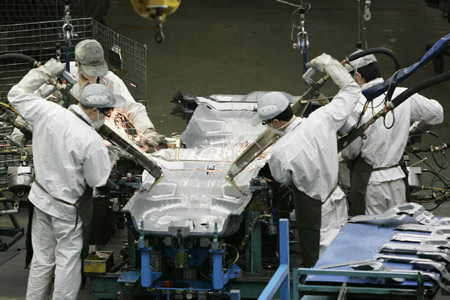
Workers at a Honda production line in Guangzhou. China's automobile sales are expected to maintain year-on-year growth of 20 percent in the next five years. [China Daily]
BEIJING - China will retain its competitive edge and remain a favorite manufacturing destination for global automakers, but the recent labor unrests may increase costs for companies, industry sources and analysts said on Tuesday.
Kevin Wale, president and chief executive of General Motors China told China Daily that the recent labor disputes will not impact the company's investment appetite in China.
"It's common. Labor issues occur everywhere, but China's huge market potential is more important," said Wale.
Foreign carmakers' success in China have been the vital cogs for their strong global performance, and hence no company can avoid its presence here, said Xu Changming, research director of the China State Information Center.
He emphasized that the recent strikes at the Honda and Toyota parts subsidiaries will not influence the investment decisions of other automakers.
"Although there are reports that some companies are pumping heavy investments into countries such as India and Vietnam, it does not necessarily mean that they are withdrawing or scaling down operations in China," said Zhong Shi, a Beijing-based auto analyst.
The labor problems of the past few weeks have forced companies to increase labor costs and put pressure on many manufacturing units which are grappling with a shortage of trained personnel.
"China has the strength to attract foreign investment on its own rather than use the 'biggest factory' tag," said Su Hainan, vice-president of the China Association for Labor Studies.
"China's competitiveness is no longer in its cheap labor," said Zhong.
"The nation's integrated infrastructure and transportation provides automakers with relatively high levels of logistics efficiency for their supply chain and vehicle deliveries. That alone, has more impact on the total cost than labor", he said.
"Most of the global automakers have been operating in China for several years now and also built up a comprehensive parts supply system. This is something that cannot be easily replicated elsewhere," said Zhong.
Honda and Toyota had indicated that they intend to improve the localization content of their cars to more than 90 percent by this year, while Nissan is targeting an import substitution rate of 90 percent by 2012.
According to Beijing-based consulting firm Sinotrust, more than 70 percent of the parts used by the local joint ventures of foreign automakers are made in China.
Moreover, "the quality of the local work force has improved over the years and is of much better standard than other Asian countries. This clearly indicates the production efficiency in China", said Zhong.
"I do not think there is anything wrong in workers seeking higher wages," said Su.
Even if employers increase wages by 10 to 20 percent every year, labor costs in China will still be lower than most Western countries.
Both Su and Zhong agree that companies need to consider a reasonable and acceptable salary increase that is in line with their capabilities, to avoid possible potential labor unrests.
"China has been the world's biggest auto market with the most promising future. Who will want to leave such a huge market?" said Zhong.
"Nearly all the foreign automakers enjoy high profit margins in China," said Xu.China's auto sales surged by 46 percent to 13.6 million units last year and helped the nation surpass United States as the biggest auto market in the world.
Automobile sales in China are expected to maintain a year-on-year growth rate of 20 percent for the next five years, said a recent survey conducted by consulting firm AlixPartners.
The brisk sales and booming demand has also forced automakers to consider capacity expansion and more investments. Nissan recently said it wants to boost productivity as costs increase.
"We need to boost productivity in China," said Chief Operating Officer Toshiyuki Shiga in a recent Bloomberg interview. "Just because labor costs are higher in China doesn't mean we are leaving," he said.