Broadband a necessity for everyone in Hong Kong
Updated: 2017-11-30 06:25
(HK Edition)
|
|||||||


In her Policy Address on Oct 11 Chief Executive Carrie Lam Cheng Yuet-ngor said "in the New Territories and the outlying islands, the progress of network coverage by telecommunications companies is slow due to the high costs of network installation and a small base" and the government would provide "subsidies to encourage the extension of fiber-based network to villages in remote locations". This is welcome but falls short of the "universal service obligation" applying to telephone service, which states that it will be "available to all people in all areas". In 1998, and again in 2007, when this policy was reviewed, it was suggested it be extended to broadband but the Communications Authority chose to leave us at the mercy of the telecoms. Officials said Hong Kong's average internet speed is among the highest in the world, adding something like: Hong Kong is a free market for telecommunications and market forces will bring us all to internet utopia. The new policy is an admission that, in fact, the wide disparity between internet access in rural and urban areas was only increasing.
So why is broadband important even to those living in "remote" (in Hong Kong terms) villages?
I edit and design books. Twenty years ago I was in an office in Central, and had a drawer full of floppy disks from authors and sent artwork to the filmmaker. Now I work from home. Publishers and authors send me documents by email; I edit the text, lay it out and send back a PDF to the author for review, to a proofreader for final check and finally to the printer. Often I also make a Kindle edition and submit that to Amazon. My work and livelihood depend critically on reliable internet. Neighbors are also working at home or telecommuting with their office. Those doing graphics and video or audio work need large bandwidth. And just about every local business uses it, for dealing with suppliers at least.
While Hong Kong has rocketed into the gigabit internet era, in most "rural" areas we have the same technology as when broadband first became available in about 2001 - digital subscriber line (DSL), a clever hack using the old copper telephone wires to carry a digital signal. This was a wonder in the 1990s. Now, it's "legacy" technology, limited in capacity and range (speed rapidly drops off a kilometer or so from the exchange), and adds excitement as the copper efficiently conducts lightning strikes into your home network, an unadvertised hazard that destroys dozens of my neighbors' computers every year (I pull the phoneline out during storms, since one killed my last PC).
Some cobble together wireless networks using mobile hotspots to get higher speed. These are intended for phones, so you easily use your monthly bandwidth in one day. But the telecoms are happy; you have no recourse if they fail as you are breaking the terms of service. So wireless users must keep searching for new companies and offers as the previous ones stop working.
Since 2001 we have seen the cost of home broadband in rural areas steadily increase - now it has more than doubled to HK$300 per month at least, while speed and reliability steadily decline, as more demand creates more frequent bottlenecks and outages. Telecom salesmen have no problem selling services the infrastructure cannot deliver; they still have their commission. Also, providing broadband only via DSL means PCCW gains a further HK$128 a month for the fixed line, even though many would otherwise have dropped it years ago.
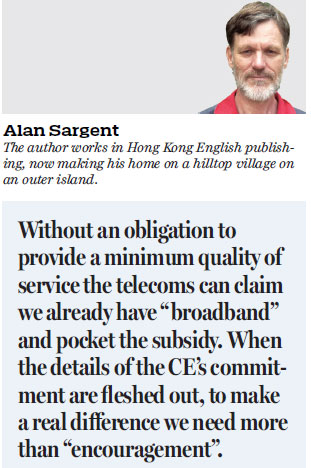
Market forces dictate that investment follows the best returns. So telecoms will always choose boosting services in, say, Mid-Levels, where they have fierce competition, rather than in rural areas where they have none. For housing, water, electricity, roads, healthcare and education the government intervenes to ensure essential services to everyone at affordable prices, either providing the service directly or requiring companies in the sector to do so. Without an obligation to provide a minimum quality of service the telecoms can claim we already have "broadband" and pocket the subsidy. When the details of the CE's commitment are fleshed out, to make a real difference we need more than "encouragement".
In areas where there is inadequate capacity, government can install the backbone by running internet fiber cables (as thick as a thumb) with the sewage, water or electricity pipes and cables which are being dug up all the time. The same contractors do the job no matter what is being laid; this would save a huge amount of money and inconvenience. The cables could be then leased or sold to telecom operators. Or maybe wireless can handle it all now: extend the subsidy to wireless home broadband (not just renamed mobile services with tiny data caps) and upgraded backbones to the cell towers. The "free market" can handle it from there.
(HK Edition 11/30/2017 page7)