Profits tax stimuli to make Hong Kong more competitive
Updated: 2017-10-12 07:39
By Oswald Chan in Hong Kong(HK Edition)
|
|||||||


Hong Kong businesses, particularly small and medium-sized enterprises (SMEs), received a big boost on Wednesday with the government set to implement two taxation policy changes in a bid to raise Hong Kong's competitiveness.
Unveiling the measures in her maiden Policy Address, Chief Executive Carrie Lam Cheng Yuet-ngor said that in order to sustain the favorable trends for the local economy, diversifying our economy is the only solution.
"The current term government is determined to boost the development of emerging industries in addition to our traditional industries, and considers that both innovation and technology (I&T) and the creative industries have a competitive edge and much potential.
"They will not only bolster economic growth, but also create quality employment opportunities for our young people," she said.
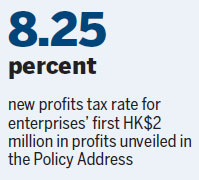
Under the two-tier profits tax plan, the profits tax rate for enterprises' first HK$2 million in profits will be lowered to 8.25 percent, or half of the standard profits tax rate, instead of the 10 percent proposed in Lam's election manifesto. Profits exceeding that amount will continue to be taxed at 16.5 percent.
To ensure that the tax benefits target SMEs, the government will introduce restrictions to ensure that each group of enterprises may nominate only one company to gain from the lower taxes.
A government source said the proposed two-tiered profits tax structure will help more than 130,000 local enterprises, slashing HK$5.8 billion in tax receipts from the government coffers. "The proposed profits tax rate change is aimed at helping local SMEs and startups trim business costs effectively. It's a good policy moving in the right direction," said Curtis Ng, vice-chairman of the taxation faculty executive committee at the Hong Kong Institute of Certified Public Accountants.
Ivan Au, Greater China divisional president at CPA Australia, said: "The proposed tax reform should also fortify Hong Kong's 'super-connector' role by luring investors from the Greater Bay Area and the Belt and Road Initiative to come to Hong Kong. We urge the government to expand overseas publicity on the tax reform package to attract more overseas direct investment to Hong Kong from global startups."
To foster research and development (R&D) expenditure in Hong Kong, another taxation policy change is that the first HK$2 million eligible R&D expenditure by private firms will enjoy a 300-percent tax cut with the remainder expenditure subject to a 200-percent tax deduction.
The government hopes that the relevant legislation could be passed next year.
In her Policy Address, Lam set a goal to double R&D expenditure as a percentage of the city's gross domestic product (GDP) - from the current 0.73 percent to 1.5 percent - during her administration's first fiveyear term.
The government hopes that private R&D investment could account for 55 percent of the total in the next five years - up from the current 45-percent ratio.
A government source expects the tax-cut proposals to double government spending on technology and innovation by HK$45 billion annually.
oswald@chinadailyhk.com
(HK Edition 10/12/2017 page6)