Look north, HK youths told
Updated: 2017-03-14 09:13
By Luis Liu(HK Edition)
|
|||||||


Easing red tape on mainland and starting national education in SAR will lure more young people to cross boundary, says NPC deputy
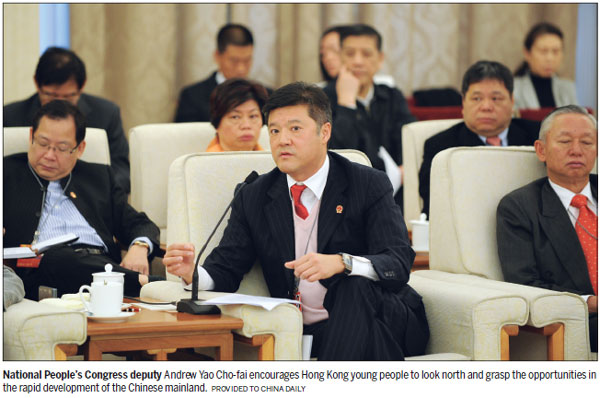
A Hong Kong deputy to the nation's top legislature has urged the city's young people to look north and waste no time in taking part in the country's development as the nation's global influence expands.
In an exclusive interview with China Daily, National People's Congress deputy Andrew Yao Cho-fai voiced concern that some young people of great promise remained reluctant to journey north.
Yao, who is also chairman of the Hong Kong-Shanghai Economic Development Association (HKSEDA), has been doing business on the mainland for 20 years. He has taken a leading role in encouraging young people from Hong Kong to find opportunities on the mainland.
Yao believes this reluctance is rooted in the present education system. "Hong Kong needs a more thorough national education," he said. Some 20 years after reunification, Hong Kong youths had no comprehensive understanding of their homeland. It would take time, he observed.
The city was separated from the motherland for more than a century, five times longer than the 20 years since reunification.
Yao contended that the solution lay at the top. A couple of years ago, he noted that a good number of professors at Hong Kong Baptist University - where Yao sits as a member of the governing council - had never applied for mainland travel permits to attend study trips sponsored by the university.
"If educators do not know about the country, what can we expect from the younger generation?" he questioned.
Yao's HKSEDA has organized visits to the mainland for 200 Hong Kong students every year for exchange and internship. When he was president of the Hong Kong United Youth Association, Yao helped more than 40,000 college students from Hong Kong, Macao and Taiwan visit the mainland for successive years, according to previous reports.
He admitted that he himself had acquired most of his knowledge about the mainland while working there.
Yao said he would increase the number of Hong Kong youth groups headed for the mainland on exchanges to help realize the vision of close cross-boundary bonds and cooperation. He also called on the incoming Hong Kong SAR administration to support the effort.
He recalled one group of students from Hong Kong, in particular. The group comprised government scholarship recipients. The students went no farther than Shenzhen to visit some of the country's leading high-technology companies.
"Talented and visionary as they (the students) were, I saw their jaws on the floor looking at the latest developments of the country's high-tech industry," Yao said.
The students visited telecommunications giants Huawei and ZTE, followed by leading drone producer DJI and internet giant Tencent.
He said trips like these were invaluable in helping young people from Hong Kong broaden their perspective.
Obstacles to dismantle
Yao noted, however, that moving to the mainland was not always a smooth or simple process, it was even more difficult for loved ones to follow their family members across the boundary.
Mainland policies remained a difficult challenge. In this year's two sessions, Yao suggested central authorities clear those barriers for young people and their families.
He noted that the mainland's bureaucratic system had disappointed many young Hong Kong people as many companies, especially those that were owned or partly owned by the State, turned down applicants who could not provide the required documents.
From the employer's side, mainland companies had to apply for a special work permit for an employee from Hong Kong. This had become a stumbling block for the companies, as the application procedure was rather complex, Yao said. An easing of regulations would be a major step forward.
For Hong Kong employees already living on the mainland, Yao urged that they obtain coverage under the mainland's insurance program and the Housing Provident Fund system.
Chief Executive Leung Chun-ying said at a press briefing last year that currently more than 350,000 Hong Kong people worked and lived on the mainland. Among them, tens of thousands were students of varying ages.
Hong Kong students on the mainland were not entitled to enroll in public schools in primary and secondary grades. That made it hard for them to settle in and enjoy a steady education, Yao said.
As a solution, in cities where most Hong Kong people chose to live, such as Shenzhen, Beijing, Shanghai and Guangzhou, Yao suggested "Hong Kong schools" be set up, using Hong Kong's curriculum and management methods. This would address the worries of young people and their parents who intended to move back to Hong Kong in the future.
luisliu@chinadailyhk.com
(HK Edition 03/14/2017 page5)