Hong Kong needs to develop a balanced view of innovation
Updated: 2016-12-30 06:58
By Naubahar Sharif(HK Edition)
|
|||||||


Recently several writers in these columns have called for Hong Kong to catch up with comparable economies in terms of research and development (R&D) capabilities - the means by which firms bring innovative new products to global markets. Indeed one writer, Professor Raymond So, argued recently that "Hong Kong needs more innovation to remain internationally competitive". So observed that Hong Kong lags behind in two major international competitiveness rankings in the area of innovation.
As a professor specializing in science, technology and innovation studies, I remind my students to maintain a balanced view of innovation, particularly as it occurs in Hong Kong. While some of the news about innovation in Hong Kong is less than inspiring, some is encouraging.
There is no denying Hong Kong's lackluster performance in annual R&D spending (as a percentage of GDP). By some measures Hong Kong is very much a laggard, especially compared with neighboring East Asian economies. Taiwan, South Korea and Singapore, for example, annually spend roughly three to six times as much on R&D as Hong Kong.
In terms of R&D intensity, Hong Kong more closely resembles the likes of Malaysia, Thailand and Vietnam. However we measure R&D, some analysts argue that Hong Kong is not a country, so it is unfair to compare it with countries that spend significant amounts on their military sectors, which typically include a sizeable R&D component. This is absolutely true.
How, then, does Hong Kong compare in annual R&D expenditures, which amount here to 0.74 percent of GDP, with other cities? Consider the annual R&D expenditures as a percentage of GDP of several major Chinese mainland cities in the most recent year for which statistics are available: Beijing, 5.95 percent; Shenzhen, 3.68 percent; Shanghai, 3.66 percent; Hangzhou, 2.98 percent; Tianjin, 2.95 percent; Foshan, 2.46 percent; Chongqing, 1.42 percent: and Guangzhou, 1.25 percent.
As these figures demonstrate, even when comparing apples with apples, Hong Kong fares poorly.
So far I've been discussing R&D expenditures, but I have mentioned innovative products as an output of R&D. What, then, is innovation? As natural as it might seem to measure innovation by R&D activities, there is much more to it.
Perhaps the best informal way to understand innovation would be to think of it simply as "doing something new". Doing something new requires new knowledge. Sometimes - but not always (and this is an important point) - doing something new also requires formal R&D. Crucially, though, there are legitimate forms of innovation that do not require formal science or technology spending on laboratory-based R&D.
Considering Hong Kong's history - as multiple authors in these columns have argued - Hong Kong has always been an extremely innovative place. There is no other way to explain how it has prospered so quickly. However, innovation in Hong Kong has manifested in ways that formal R&D statistics do not capture. Beyond scientific and technological R&D, there are other aspects of innovation in which Hong Kong has established a strong tradition, profited from it and developed useful capacities.
These capacities include:
Absorbing global knowledge, adapting technology, and recombining and synthesizing knowledge into new productive configurations;
Relying on agile sensitivity to changing demand to learn quickly from advanced customers and markets through creative imitation;
Deploying organizational flexibility and orchestrating loosely coupled networks and business processes;
Systematically developing quality control.
If Hong Kong's strength lies in pursuing non-technological innovation, then, why should it increase R&D spending on technological innovation? Well, as Hong Kong transitions into a knowledge-based economy - the best way to ensure continued economic growth in the 21st century - it absolutely must emphasize various forms of knowledge, of which technological R&D is an extremely critical component. The goal is not, of course, to turn Hong Kong into yet another Silicon Valley, but simply to expand the economic base beyond its four pillar industries of financial services, trading and logistics, tourism, and producer and professional services. That is the key to continued growth and development.
Still, many individuals, groups and companies in Hong Kong engage in non-R&D-related innovative activities that add value, move the economy up the value chain, increase competitiveness and contribute to rising employment. This is Hong Kong's strength, however difficult to measure it might be, and Hong Kong should continue such activities in conjunction with growing new, formal technological R&D capabilities.
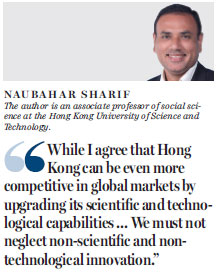
Therefore, while I agree that Hong Kong can be even more competitive in global markets by upgrading its scientific and technological capabilities (and its stellar university system can help fuel this effort), we must not neglect non-scientific and non-technological innovation - precisely the type of innovation that Hong Kong has leveraged to great effect over the past several decades.
Combined efforts on both fronts will generate a real improvement in Hong Kong's innovative capabilities.
(HK Edition 12/30/2016 page1)