Belt and Road Initiative poses new challenges to Hong Kong
Updated: 2016-11-17 07:19
By Zhou Bajun(HK Edition)
|
|||||||


In Hong Kong, be it to businesses or the media, the Belt and Road (B&R) Initiative is either something of a puzzle or just headlines like "Belt & Road Initiative Brings Hong Kong Opportunities for New Development". At a glance these two responses seem unrelated. But a closer look reveals a common problem: Hong Kong faces a challenge to correctly understand the B&R in order to find its right place in this grand vision.
I would like to begin my analysis with a recent report from Russian News Agency TASS dated Oct 4. It says the Eurasian Economic Union (EEU) and China will begin the first round of talks on establishing a free trade area among them in Moscow in mid-October. Russian Prime Minister Dmitry Medvedev was scheduled to meet with his Chinese counterpart, Premier Li Keqiang, in St. Petersburg on Nov 7-8. They discussed topics such as preparations for the Greater Eurasian Economic Partnership (GEEP) agreement. Apart from EEU member countries and China, countries like India and Pakistan are also interested in joining the GEEP.
You may wonder why I think this news is important. It is because it fits into the B&R strategy quite nicely as an organic part. It demonstrates the nature of B&R from another perspective. So far the international community has been largely misled by many Western media on what the initiative really is. This misunderstanding resulted from a lazy comparison with the Marshall Plan of the immediate post-war era. This led to the assumption that the B&R Initiative is another international cooperation drive led by China; when in fact it follows the principles of equality, cooperation and mutual benefit. It aims to build a community of shared interests with a common destiny.
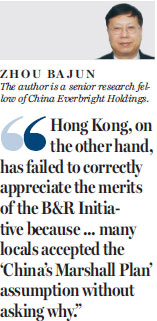
There is no denying the global economic center of gravity is shifting from the West (Europe and North America) to the East (Asia) and B&R is a logical phenomenon in that process. However, against the backdrop of globalization that has proceeded in leaps and bounds for the last 50 years or so, it is impossible for the West-to-East economic shift to result in the splitting of the East from the West. On the contrary, the bond between Europe and Asia has strengthened as a natural outcome of this historic change. This explains why Great Britain, Germany and France were the first European nations to join the Asian Infrastructure Investment Bank (AIIB). It also explains why China and Russia are jointly pushing for the establishment of the GEEP. Hong Kong, on the other hand, has failed to correctly appreciate the merits of the B&R Initiative because it was so thoroughly influenced by the West for so long that many locals accepted the "China's Marshall Plan" assumption without asking why.
Based on this assumption an idea has emerged that Hong Kong can make special contributions to the B&R Initiative by taking advantage of its role in the economic reform and liberalization of the mainland. On the other hand, we have also heard concerns about the risks in dealing with "non-Western" markets along the B&R that Hong Kong is not so familiar with. Some people in Hong Kong know hardly anything about the B&R Initiative. Others are content with just one generalization that it "will bring Hong Kong new opportunities for development".
There is no doubt the B&R Initiative creates challenges as well as opportunities for Hong Kong. No one should underestimate these challenges while trying to seize the many opportunities. The SAR government, together with the education sector and media, should help get Hong Kong society up to speed with things. People should know more about the initiative. Most Hong Kong residents know little about many non-Western countries along the ancient "Silk Road" and "Maritime Silk Road". Many businesses have no experience in dealing with these markets. Hong Kong's media generally focus on Western countries much more than on "lesser" ones in their coverage of world news. This lack of objective knowledge about the B&R Initiative will prevent Hong Kong from seizing some of the opportunities it creates.
These opportunities are always accompanied by challenges. No one can have one without the other. Hong Kong may not know some of the markets along the B&R trade routes. But this does not mean it should just watch on the sidelines. It is absolutely true that opportunities are for those who are prepared. They should be prepared not just for opportunities but for the challenges as well.
(HK Edition 11/17/2016 page8)