Middle-class Chinese appetite for art paints a bright future
Updated: 2016-10-19 07:06
By Duan Ting in Macao(HK Edition)
|
|||||||


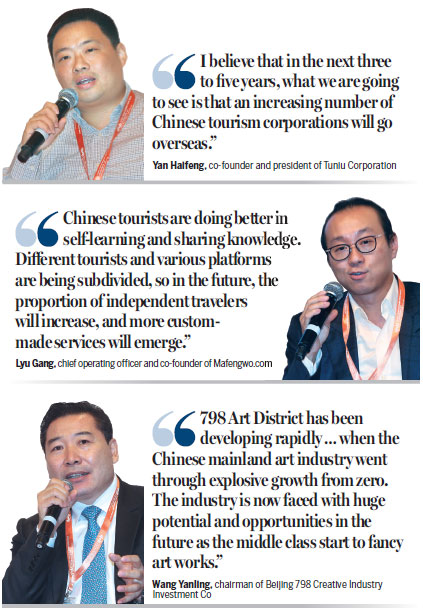
China's arts sector has the potential for enormous growth and countless opportunities as the middle-class begins taking an interest in purchasing artworks, said the Beijing-based founder of 798 Art District Wang Yanling.
But, despite the increased interest in art, he said it will be hard to recreate the roaring success of the artistic hub near Beijing.
"However, the thriving development of 798 is not easy to copy," reckons Wang, chairman of Beijing 798 Creative Industry Investment Co that runs the arts district, which has benefited from the rapid rise in the country's art industry.
He said the accumulation of art institutions is the key criterion in developing an arts district, which will pull the development of related industries.
The 798 Art District is located in the Dashanzi area in the northeast of central Beijing. It is the site of State-owned factories, including Factory 798, the complex of a 50-year-old decommissioned military factory originally producing electronics.
According to Wang, the complex was open to rent due to company restructuring and needed to raise funds in the late 1990s. After an artist moved his studio into the complex in 2000, it ushered in other artists who were looking for places to stay. Soon enough, 798 Art District began attracting numerous workshops to rent out, factory spaces were remodeled and the complex gained global attention in less than two years.
"798 Art District is a gathering place for Chinese contemporary arts and a window for foreigners to know Chinese arts," said Wang.
The district has snowballed into more than 500 art institutions, including galleries, art centers, artists' studios, design companies, restaurants and bars. More than 2000 arts events were held in the 798 Art Zone last year, welcoming more than four million visitors, a quarter of whom were foreign visitors. A total of 120 heads of State have visited the district so far.
Wang said an art district usually goes through three development phases - the gathering of artists, trading of art works and entering of fashion brands. Eventually, the location becomes high-end real estate.
He points out that they are making efforts to break through the traditional development routine, aiming to expand the artistic community to become a global culture and art center. Wang said the focus is now on fashion, high-end travel and art finance.
"The nature of art is innovation and creation."
As part of his ambitious plans for the district, Wang hopes it will have more than 400 fine arts institutions by 2020, with more than 3,000 art events and more than 5 million visitors.
Another new concept is an O2O (online-to-offline) project called e-party that combines technology with art, providing exhibitions available to view offline and online auction sale services.
tingduan@chinadailyhk.com
(HK Edition 10/19/2016 page9)