Trendy tenants pick up the slack as malls reap healthy profits
Updated: 2016-09-21 07:08
By Lin Wenjie in Hong Kong(HK Edition)
|
|||||||


|
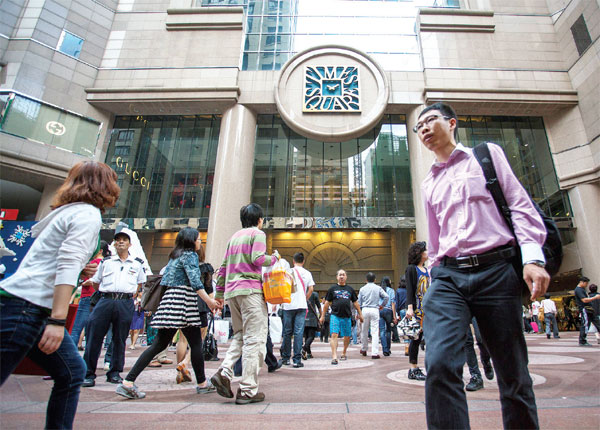
Times Square in Causeway Bay has seen a big jump in luxury-brand shops being closed for renovation lately. To cushion the blow in the retail sector, Hong Kong shopping malls are trying to bring in more affordable brands catering to the mass market. Jerome Favre / Bloomberg |
Hong Kong is in the midst of a retail "winter" with the luxury goods sector being the hardest hit, which may reduce shopping malls' bargaining power with tenants.
But, contrary to popular belief, rental income in some malls had grown in the first half of the year due to big demand from trendier brands and restaurants that don't cater to high-end shoppers.
Times Square - a major shopping center in Causeway Bay and a tourist attraction in its own right - had 26 shops closed for renovation last month - more than 10 percent of its total of 224 shops. Most of them are located on the eighth floor, which usually houses shops selling luxury watches and diamonds.
"The shops being refurbished are preparing for the new brands to come in, but the vacancy rate hasn't gone up," said Doreen Lee Yuk-fong, vice-chairman of Wharf Holdings which owns Times Square, adding that retail rents had yet to come down.
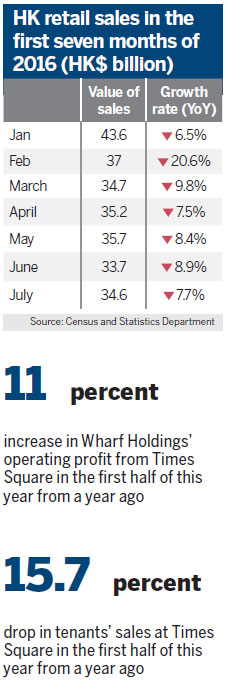
Wharf's interim results showed that its operating profit from Times Square rose 11 percent in the first half of this year to HK$1.3 billion, compared to a year earlier. Its occupancy rate was steady at 99 percent, but tenants' sales had dropped by 15.7 percent to HK$3.9 billion.
Harbour City - another prime shopping complex under Wharf - also recorded profit growth despite weak market conditions. The complex's operating profit increased 5 percent to HK$3.95 billion, with its occupancy rate steady at 100 percent. However, tenants' sales were also down, by 14.7 percent, during the period to HK$13.3 billion.
Lee said retail sales had improved in June and July. She believed that the sales performance for luxury goods had bottomed out and remained "cautiously positive" about future market prospects.
Other department stores have achieved even stronger growth in rental yields. Hong Kong's largest developer Sun Hung Kai Properties (SHKP), which owns IFC Mall, New Town Plaza and East Point City with a portfolio of more than 10 million square feet, saw its performance in the retail sector "relatively resilient", but it didn't disclose figures in its interim report.
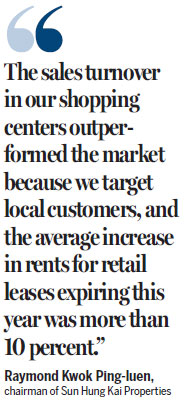
"The sales turnover in our shopping centers outperformed the market because we target local customers, and the average increase in rents for retail leases expiring this year was more than 10 percent," SHKP Chairman Raymond Kwok Ping-luen said after the release of its interim report last month.
Sun Hung Kai Real Estate Agency General Manager Maureen Fung Sau-yim said aggregate sales turnover jumped 8 percent in July to HK$1.6 billion for SHKP's 12 shopping malls, while traffic surged 9 percent.
With the prestige of being a shopping paradise, Hong Kong's retail sales saw double-digit growth from 2010 to 2013, but this came to a halt in February 2014 as fewer Chinese mainland tourists came to the city.
The sluggish performance has carried on to 2016, with the aggregate value of retail sales plunging 10.5 percent year-on-year in the first half of 2016 - the steepest drop in 17 years. The luxury goods sector, including jewelry and watches, took the biggest hit, while department store sales slipped 10.5 percent.
Despite dwindling sales, restaurant receipts grew 2.5 percent during the same period, showing that demand for food is relatively inelastic.
The city's retail sales declined 7.7 percent from a year earlier to HK$34.6 billion in July in value terms, hurt by fewer big-spending tourists, persistently weak consumer sentiment and a strong local dollar, according to the Census and Statistics Department.
To cushion the blow in the retail sector, shopping malls are bringing in more affordable brands. According to the latest research report from US property advisory firm CBRE, Hong Kong attracted the highest number of new retailer entrants last year. Among the 73 new entrants, more than half were restaurants.
"Rents have continued to rise in Hong Kong's shopping centers amid a sluggish retail sector, implying there's still strong tenancy demand from those affordable, trendy brands and restaurants, and there's still an undersupply of retail space in shopping malls," said Joe Lin Chi-ho, retail services executive director at CBRE Hong Kong.
"Local shopping malls are eager to introduce new brands and restaurants that follow the latest trend, like South Korean fashion boutiques and pop-up stores, in an attempt to differentiate themselves and lure younger customers," he said.
Pacific Place mall in Admiralty had a hugely successful pop-up by hazelnut spread manufacturer Nutella. The pop-up sold 350-gram jars of hazelnut spread, with clients customized to the jar label with a name. The HK$80 product was more than double the cost of a regular jar, but this didn't stop them from selling 17,000 jars in just 24 days.
Despite the tough retail conditions, shopping areas in Hong Kong have continued to expand rapidly. According to a UBS report, more than 24 new shopping centers are due to be completed by 2018, providing 1.6 million square feet of retail space.
Adding to that, 23 industrial revitalization projects have been approved for conversion to retail facilities with an extra of 1.9 million square feet of retail space.
cherrylin@chinadailyhk.com
(HK Edition 09/21/2016 page7)