Revitalizing our ferry services will meet multiple demands
Updated: 2016-07-20 07:51
By Alan Sargent(China Daily)
|
|||||||


Most residents of Hong Kong are aware of the meaning of its name - "Fragrant Harbor". For quite a while the word "fragrant" has seemed ironic, but "harbor" is also losing its relevancy.
The city exists because its location gave European traders access to Canton (or Guangzhou), and later to other ports along the China coast. The deep natural harbor was soon complemented by port facilities, dry docks, warehousing and other support for sea trade. Meanwhile, the settlements on Hong Kong and the other islands were connected by sailing and later steam craft. Given that much of the territory is very steep and mountainous, it was, and in some places still is, easier to get from one area to another by boat than via circuitous hilly tracks. In 1873 the Star Ferry began its services across Victoria Harbour. The Hongkong and Yaumati Ferry started on other routes including the outer islands in the 1920s. By the 1960s it was the largest Chinese company in the world, running over 100 ferries.
But in the 1970s, with tunnels under the harbor for vehicles and the Mass Transit Railway (MTR), ferries went into a decline.
Hong Kong seems to be turning its face away from its maritime heritage. Many go for years without visiting the shore or traveling on a boat, only going under the harbor by train or bus. While the government proudly announces plans for multibillion-dollar reclamations for new bridges, tunnels and roads, it seems reluctant to invest in what makes our city unique: the harbor front and its ferries. The government says it cannot subsidize public transport, yet billions are spent on infrastructure for road and rail transport, which may even impede the operation of ferries. Today many ferries are only fading memories, while the Star Ferry is losing passengers due to the pier being relocated. Now it is a long walk away instead of just beside the General Post Office.
Last November a barge collided into the Tsing Ma Bridge and shut down traffic to the airport for a few hours, resulting in significant economic loss and missed flights. Though we suffer longer airport closures several times a year due to typhoons, this was deemed a crisis. A new bridge was promised, at a cost of more billions.
Meanwhile, every rush hour, and over most of the weekend, the roads to Sai Kung are choked with traffic. The solution to that? Decades of roadworks are planned. Meanwhile, Sai Kung has been a port for centuries; it has piers ready to serve any number of ferries. All they need are some turnstiles.
A fleet of ferries could be deployed quickly to serve coastal centers like Sai Kung, and when needed, Chek Lap Kok. Unlike road and rail which require massive investment and huge amounts of our valuable real estate to operate a new route, or housing estates gifted to them as the MTR enjoys, all ferries need are piers. And we still have those in many places. If each form of transport was costed by including all the infrastructure the government provides, rather than just the direct subsidies to operators, the ferries probably come out pretty low per passenger-kilometer. How about environmental costs? Currently many ferries are burning smoky diesel fuel. Why not mandate that all new ferries should be powered by natural gas? Fund a conversion program for existing ferries. The government is now paying bus operators up to HK$892,000 to replace each older bus to improve air quality so this is not a radical idea. It is much easier to regulate the emissions of a few dozen ferries than thousands of buses and cars.
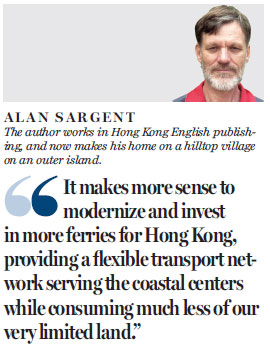
Current policy is one of managing a decline, taking every opportunity to shut down ferry routes. I believe it makes more sense to modernize and invest in more ferries for Hong Kong, providing a flexible transport network serving the coastal centers while consuming much less of our very limited land than the roads favored by our automobile-obsessed Transport Department. Do tourists come to Hong Kong to ride on buses or trains? Every real tourist makes a point of going on the Star Ferry at least. And not just tourists. You don't have to be invited on a corporate junk or go on a tourist tour. I've lived on an "outer island" for the last 25 years. Coming to and from Central by ferry is the most relaxing part of the day, a feeling shared by many of my fellow commuters. On a fine day I can get a seat on the afterdeck and enjoy the sea air, for HK$14. Ferries have always been a convenient, cheap and enjoyable part of life in Hong Kong. It would be a shame to lose our practical, efficient and iconic ferries by neglect.
(China Daily 07/20/2016 page10)