Fighting poverty in the city must be a long-term goal
Updated: 2015-11-04 09:22
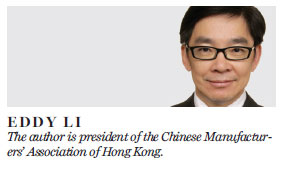
By Eddy Li
|
|||||||


According to the Hong Kong Poverty Situation Report 2014 released by the SAR government recently, the city's poor population after recent government initiatives declined slightly to 962,000 from just over 1 million in the previous year. The poverty rate also gently dropped to 14.3 percent from 14.5 percent, which is the lowest since the year of 2009. This improved poverty situation can be attributed to two factors: A low unemployment rate which the city has managed to maintain and healthy public finances, which allows the government to allocate more resources to poverty alleviation and to improving people's livelihoods.
If we really want to develop the economy, I've always thought it was necessary to attach more importance to tackling poverty. In modern management science, a theory called the Cannikin Law, or the Wooden Bucket Theory, suggests that a bucket's capacity is determined by its shortest stave. By the same theory, a chain is only as strong as its weakest link. The "shortest stave" restricts the overall capabilities of a society in the same way.
Central to Hong Kong's poverty is the "shortest stave". There will never be sufficient resources if we ignore the weakest link. But if we reinforce the weakest point, the development of society will proceed to the next level. The Cannikin Law teaches us that the crucial point for economic success is taking advantage of our strengths as well as helping the most vulnerable sectors.
The Commission on Poverty has indicated that a series of poverty alleviation measures will be launched - including the Low-income Working Family Allowance Scheme. The scheme is about to be introduced from the second quarter of next year to help low-skilled workers. It is estimated that implementation of this scheme will benefit 200,000 families and 700,000 people, including 170,000 children and teenagers. This measure, I believe, will definitely help in lowering the level of poverty.
The government published the first official poverty line in September 2013, by setting the line at 50 percent of median household income. This is different from the World Bank's standard of an extreme poverty line at an income of $1.9 a day, but the statistics calculated by the SAR government is still valuable for reference.
The past several years have witnessed a decline in the number of poor people in Hong Kong, which is certainly welcomed by all sectors of society. Judging from the current forecast for future economic and social situations, however, it is very difficult to continue to alleviate poverty.
We are facing multiple difficulties and the first sign of some negative factors affecting our economy. Externally speaking the US has been preparing for a new cycle of interest rate increases; while the mainland economy is slowing down and entering into a period of moderate economic growth. Under these circumstances, it is extremely hard for Hong Kong to maintain high levels of growth. Along with the internal challenges the city faces are the continuous decline in the growth of visitor numbers and a downturn in the retail industry. In the first half of 2015, the total retail sales in Hong Kong decreased by 1.6 percent, in which the sales of luxury goods dropped by a substantial 16 percent. Other economic statistics also hint at negative prospects and do not bode well for the employment situation in Hong Kong.
Second, the trading volumes of both the stock and property markets are declining. Over the past few months, Hong Kong's stock market suffered some corrections, resulting in a lower volume of transactions. And because of slower economic growth and the fear of interest rate increases, property investors tend to be more conservative. According to the Land Registry, during the third quarter of the year, there were only 1,119 transactions of second-hand properties valued at more than HK$10 million each, 6 percent lower than the previous quarter. As a result of declining property transactions, government revenue from stamp duty, a significant source of revenue for public finance, is likely to fall. This will have an adverse impact on the economic strength of the government.
Another important factor is the negative impact of society's politicization. Filibustering stunts are now commonplace in the Legislative Council. Radical legislators spare no effort to delay government policies. These include those that relate to poverty alleviation and people's livelihoods.
As the city's ageing population gets older, demand for retirement protection, medical and other services for the elderly will inevitably grow, requiring more and more government support. It will be a long time before policies to alleviate poverty in Hong Kong will no longer be needed.
(HK Edition 11/04/2015 page9)