Mutual-fund program to spur investor appetite
Updated: 2015-05-28 08:51
By Yang Ziman(HK Edition)
|
|||||||


The upcoming mutual-fund recognition program between Hong Kong and the mainland is likely to have a greater impact on both individual and institutional investors than the Shanghai-Hong Kong stocks cross-trading program, with analysts projecting a huge inflow of mainland funds to take advantage of the city's low evaluation of local share prices.
Regulators on both sides announced last Friday they would partly open up their respective markets to investment funds. The pilot mutual-recognition program, which will allow funds registered in one jurisdiction to be marketed to investors in the other, will start on July 1.
Pi Haizhou, an independent stocks analyzer, explained that the opening-up of fund trading will help clear the air in the operations of the mainland and Hong Kong bourses.
"The Shanghai-Hong Kong Stock Connect program has not given much motivation to individual and institutional investors to invest in each other's stock market because they are not familiar with the situation on each side," Pi wrote in his blog.
"Mutual recognition of funds will enable investors to buy funds in each other's market so as to indirectly invest in the stock markets.
"The evaluation of H shares remains very much lower than that of A shares. Therefore, Hong Kong stocks stand to benefit more from the latest move as more capital will be heading south (to Hong Kong) rather than north (to Shanghai)," Pi said.
Since November last year, the growth-rate gap between A and H shares has widened, with the Shanghai Composite Index having gone up by 83 percent, while the Nasdaq-style index tracking the growth of enterprises in the Shanghai Stock Exchange, or ChiNext, has soared 123 percent and the Hong Kong Hang Seng Index's 15-percent growth seems minimum, says a report by Guangzhou-based GF Securities Co Ltd.
According to the report, the A-share stock valuation is significantly higher than that of H shares, and the valuation of small-cap stocks in the A-share market is more than four times that of the Hong Kong Stock Exchange.
In terms of investment portfolio, GF Securities has found that its investors tend to buy H shares with a big gap in prices or stock evaluation compared with A shares. It also found that most investors go for medium- and small-cap stocks as they believe there's huge potential, and that the TMT (technology, media and telecommunications) industry is the most popular followed by the consumption sector, State-owned enterprises and financial enterprises.
Zhang Feng, manager of overseas investment at Shanghai-based Fullgoal Fund Co Ltd, told a recent forum that the evaluation of large-cap shares issued by Chinese mainland companies listed in Hong Kong is generally 30-percent lower than their A-share evaluation, which means H shares can expect larger growth potential.
"Medium- and small-cap companies listed in Hong Kong are a lot cheaper than stocks of companies listed on ChiNext. Compared with companies in the same industries, H shares are much cheaper than A shares. There're a lot of opportunities for a 'free lunch' in Hong Kong," said Zhang.
Statistics have shown that in a bull market, H shares may eventually grow equally significantly as A shares although the growth might not be sizeable in the beginning.
"Investors can reap the benefits of a bull market twice. I believe there's a big chance that H shares will follow suit in line with their mainland counterparts," Zhang added.
The mainland has a massive pool of domestic savings, most of it sitting in bank accounts, according to a report on the future outlook of Chinese mainland-Hong Kong mutual funds released by Ernst & Young last year.
"It's predicted that depositors will look increasingly toward investments rather than cash as households seek ever higher returns - even a small percentage shift into investments will be considerable in absolute terms," said the report.
According to the document, the mainland's asset-management industry is still very small in absolute terms, with total assets of about 30 trillion yuan ($4.7 trillion) as of December 2012.
yangziman@chinadaily.com.cn
|
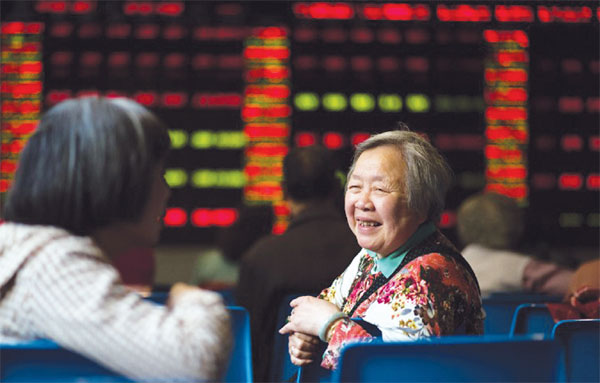
Medium- and small-cap stocks traded in Hong Kong are a lot cheaper than their counterparts on ChiNext. Thus, there's still considerable space for speculation under the mutual-fund recognition program between Hong Kong and the mainland. Asia News Photo |
(HK Edition 05/28/2015 page8)