Push for mature RMB bond market in HK
Updated: 2015-04-29 07:10
By Yang Ziman(HK Edition)
|
|||||||


|
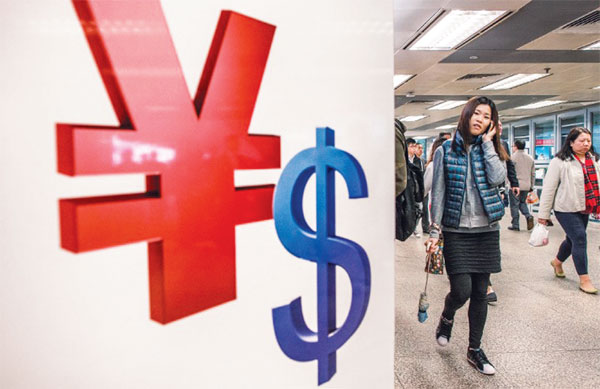
On the city's path to create a more efficient Asian bond market, the fluctuation of renminbi is one of the biggest obstacles, while low liquidity and the lack of a renminbi exchange-rate benchmark would hinder the development of renminbi-denominated bonds in Hong Kong. Asia News Photo |
SAR urged to play key role to back 'One Belt, One Road' initiative
Hong Kong should make a concerted effort to fully develop a renminbi-denominated bond market in Asia in the context of the mainland's "One Belt, One Road" initiative, economists say.

The success of the initiative will rely on a mature Asian bond market; and the Chinese mainland, which accounts for more than 60 percent of the market, plays a key role in the region, said Michele Leung, director of fixed income indices at S&P Dow Jones Indices.
The mainland's bond market has expanded rapidly in recent years, with the market value tracked by the S&P China Bond Index having soared by 70 percent since the index was first valued on Dec 29, 2006, while the corporate bond market has expanded four-fold. 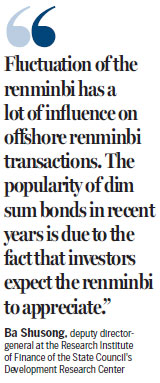
Hong Kong, designated as the first city for offshore renminbi trading, is currently the world's biggest offshore renminbi transaction hub. The city's offshore renminbi-denominated bond market is also the largest of its kind worldwide.
According to Boston Consulting Group Inc, Asia's bond market remains highly untapped as it accounts for only 18 percent of the region's financing means - a far cry from 50 percent in the US and 36 percent in Europe.
The total value of renminbi-denominated bonds in Hong Kong is about 700 billion yuan ($112.8 billion), compared with 36 trillion yuan in domestic bonds on the Chinese mainland.
"Within a year, China's bond market had grown significantly by 22 percent, as of April 27 this year. The 'One Belt, One Road' initiative is expected to fuel the robust growth of the China bond market," Leung said.
Ba Shusong, deputy director-general at the Research Institute of Finance of the State Council's Development Research Center, reckoned that the allocation of financial resources in Asia is severely lopsided.
He explained that Asia's foreign reserves currently account for only two-thirds of the global total, a large proportion of which has been spent on national US bonds.
He said the renminbi, in its push to be more internationalized, should be used to tap the huge Asian reserves through the issuance of stable and high-yielding bonds.
Another driving force for renminbi-denominated bonds in Asia is capital demand under the "One Belt, One Road" plan, Ba said. 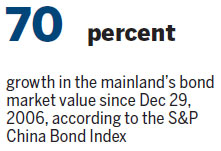
According to the Asian Development Bank, Asian countries need $8 trillion from 2010 to 2020 to ensure that their domestic infrastructure programs reach the world's average level. The World Bank estimates that infrastructure construction in mid- and low-income countries requires $1 trillion.
Organizations like the Chinese mainland-led Asian Infrastructure Investment Bank, the Shanghai Cooperation Organization, the New Development Bank and a series of development funds established by China and neighboring countries will also generate a lot of financing and investment demand, Ba said.
However, Hong Kong still faces challenges in creating a more efficient Asian bond market. 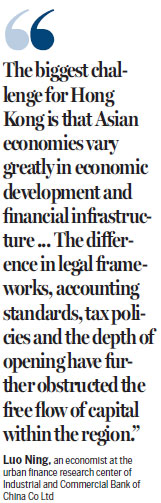
"The biggest challenge for Hong Kong is that Asian economies vary greatly in economic development and financial infrastructure," said Luo Ning, an economist at the urban finance research center of Industrial and Commercial Bank of China Co Ltd.
"Also, many Asian enterprises are small, making it difficult for them to enter the capital market. The difference in the legal frameworks, accounting standards, tax policies and the depth of opening have further obstructed the free flow of capital within the region," he said.
"Fluctuation of the renminbi has a lot of influence on offshore renminbi transactions. The popularity of dim sum bonds in recent years is due to the fact that investors expect the renminbi to appreciate. Therefore, they prefer dim sum bonds for their high liquidity and short due time rather than their rate of return," said Ba.
Other problems, he noted, include low liquidity and the lack of a renminbi exchange rate benchmark, which hinder the development of renminbi-denominated bonds in Hong Kong.
Zhang Cong, an analyst at China Chengxin International Credit Rating Co Ltd, said the types of renminbi-denominated bonds in Hong Kong are limited since a large part of bonds are government debentures on the Chinese mainland with short mature time. At present, the US dollar-dominated bond market offers more advantages than dim sum bonds in Hong Kong as they have a wider range of due time - from five years or 10 years up to 30 years. Yet, dim sum bonds usually mature within three years.
"More diversified bond maturity and transparent information disclosure will guarantee the development of renminbi-denominated bonds," Zhang said.
"In the long run, product variety should be expanded from sovereign and quasi-sovereign, which currently dominates the market, to credit exposure, or corporate bonds, in order to meet the demands of various investors," Leung added.
yangziman@chinadaily.com.cn
(HK Edition 04/29/2015 page9)