'Occupy Central' has damaged the rule of law
Updated: 2014-12-11 07:56
By Lee Ming-sang(HK Edition)
|
|||||||


The illegal "Occupy Central" movement appears to be obstinate. Neither democracy nor the rule of law - two of society's most fundamental institutions - seems able to tame it at present. What has Hong Kong done wrong?
Let's first discuss democracy. Popular opinions about "Occupy" were always clear from the beginning. In every opinion poll conducted from the time when the "Occupy Central Manifesto" was published last year until the protests began in September, opponents outnumbered proponents. Polls taken since it began have shown growing opposition because the campaign became more violent. The occupiers had remained oblivious to increasing public criticism. As one opposition lawmaker publicly stated, "We will firmly maintain our stance no matter how popular sentiment changes." There is little doubt the illegal movement is virtually immune to popular opposition.
However, Hong Kong's democratic system does affect opposition decisions, as shown in the reluctance of the "moderate" faction to embrace all-out radicalism. It could have been out of concern over their prospects in the next Legislative Council (LegCo) elections in 2016 or chances of entering the 2017 Chief Executive election. The fact is "moderate" opposition parties have changed their attitude to "Occupy" in recent weeks. This is after growing public concern over the violent attacks on the government headquarters.
Although these parties may find themselves unable to convince either side, there is no denying their decisions have been influenced by concerns about future elections. Voter support clearly matters. But this is only true among the "moderates" - not the radicals - even though the latter are a minority. But elections don't worry protesting students.
The "Occupy" campaign was triggered by a strike organized by two radical student organizations. They immediately assumed leadership of the movement. It is no surprise idealism and anarchism has been widespread among young protesters. The students believe they are fighting for justice and "universal values". Their total disregard for popular sentiment has been bolstered by misplaced support from a biased press. They actually believe they can ignore the opinions of older people and trample on the freedoms of others.
As long as elections by proportional representation remain, the minority radical faction need not worry. Owing to geographical and functional constituencies its members can win LegCo seats by securing as little as 10-20 percent of the vote. That is why extreme radical groups will do anything to keep "Occupy" alive. It allows them to build their influence among future voters and prevent universal suffrage from happening.
These two radical factions have dominated the dwindling ranks of the "Occupy" crowd. They managed to gather enough followers to mount violent attacks on two occasions, on the LegCo complex and government headquarters last month. All signs indicate that they are highly unlikely to turn themselves in as the initiators did, or to voluntarily abandon the illegal campaign. Judging by the change in tactics after the occupation site in Mong Kok was cleared, these two radical factions are likely to cause further problems in the weeks and months ahead. They have no respect for the spirit of democracy or the rule of law.
Under normal circumstances the rule of law serves to deter criminal tendencies and bring about justice by convicting and punishing the guilty. It's a shame these elements of the rule of law have so far not worked with "Occupy".
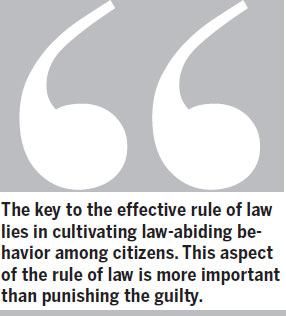
The key to the effective rule of law lies in cultivating law-abiding behavior among citizens. This aspect of the rule of law is more important than punishing the guilty.
Hong Kong has every reason to be proud of its achievements in this area. This also makes "Occupy Central" all the more contemptible. It has reduced one of our most precious values to virtual irrelevance with its claims to "civil disobedience". Moreover, it has led to the loathsome prospect of widespread lawlessness. Imagine if the occupiers succeeded in seizing power in Hong Kong!
In just two months, the illegal movement evolved from peaceful sit-ins in the beginning to resisting police removal en masse. They violently attacked government headquarters as well as police officers with potentially lethal weapons as well as the brazen infringement of ordinary people's basic rights - all in the name of "civil disobedience".
Of all the damage caused by the "Occupy" campaign, overturning established beliefs about the rule of law is undoubtedly the worst. It has also been the most corrupting in the long-term. Its twisted definition of civil disobedience could completely destroy Hong Kong by reducing the rule of law to a toothless tiger. This is reflected in the fact that it has been difficult for the police to enforce the law.
Even if the authorities successfully cleared the remaining barricades, some occupiers would find other ways to challenge the rule of law. Relevant authorities as well as local residents must be prepared to deal with them.
The author is a veteran current affairs commentator.
(HK Edition 12/11/2014 page9)