Hong Kong can resolve its current divisions
Updated: 2014-07-09 07:14
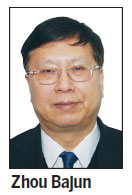
By Zhou Bajun(HK Edition)
|
|||||||


In view of Hong Kong's current tense political situation, certain observers believe the city reminds them of what it was like during the pre-1997 handover days. On June 27, the South China Morning Post carried a commentary by Michael Chugani, who suggested "Today's Hong Kong recalls the fear-filled days leading to the handover". He added that Hong Kong in 2014 was "only angrier and more polarized". However, the city faces quite different challenges today than those of the past.
About 30 years ago, the historical challenge for Hong Kong was to design a framework which could transform it from a British colony into a special administrative region of China. The 1984 Sino-British Joint Declaration provided an outline for what would follow after July 1, 1997. The details of the constitutional framework are enshrined in China's Constitution and the Basic Law of the Hong Kong Special Administrative Region (HKSAR). With the recent release of the white paper the opposition camp has suggested that Beijing has reneged on its obligations under the Sino-British Joint Declaration. These suggestions are mere conjecture.
A critical issue in the debate concerns what Hong Kong's jurisdiction is ultimately based upon - the nation's Constitution? - Or the joint declaration? Before the handover this was a conceptual question. But after 17 years under the "One Country, Two Systems" principle, the city is facing practical problems. Heated debates about this continue. The great challenge facing Hong Kong today is finding a resolution to these issues.
The majority of commentators use the word "polarized" to describe Hong Kong's political situation. Some of them believe it is the central government's fault. For example, an op-ed piece titled "Hong Kong and China a showdown looms" in The Economist (June 21) says: "For years after the return of Hong Kong to Chinese sovereignty in 1997, China's leaders surprised the world by adhering scrupulously to Hong Kong's unusual political set-up of 'One Country, Two Systems'...In recent years, however, party leaders in Beijing have become less respectful of that system, and that is stirring up resentment."
If Beijing "surprised the world by adhering scrupulously to Hong Kong's unusual political set-up of 'One Country, Two Systems'", then what could have made the central government change its attitude "in recent years"? In my opinion, it was changes in the HKSAR's political landscape. In this column I have pointed out more than once that Hong Kong, as a crowded SAR with a population of over 7 million people, has to pursue economic integration with the mainland. Politically, however, the local opposition camp has been doing everything it can to oppose the central government. This includes violating the Basic Law and the "One Country, Two Systems" principle.
In terms of economic integration, some of Hong Kong's "core values" appear to clash, in certain areas, with the mainland's. As business and trade has encouraged communication and the exchange of information across the Shenzhen River, ideological differences between the two sides have emerged. These have helped spark political debate. To deal with this, the central government needs to support Hong Kong's economic development and help clear up the political confusion.
But the opposition camp is making Hong Kong-mainland economic integration as difficult as it can by focusing upon the differences in the two communities. They have threatened to paralyze the city's financial district with the illegal "Occupy Central" campaign in the name of "genuine universal suffrage".
The organizers of "Occupy Central" seem to believe they can force Beijing into making concessions on constitutional reform in Hong Kong. Now they know this to be unrealistic they have abandoned this particular objective, but are nevertheless going to launch the mass protest. Recently, opposition lawmakers have blocked bills in the Legislative Council (LegCo). They encouraged violent attempts by their supporters to force their way into the LegCo building. Following the July 1 march, radical factions of the opposition camp staged a "dress rehearsal" for "Occupy Central" in Chater Road. The police were obliged to enforce the law. They arrested 511 individuals at the scene - a new record for Hong Kong.
The city has been so engrossed in this political struggle that many have become unaware of the problems facing the economy. On July 3, only two days after the march, the SAR government released its second quarter statistics. These are worrying. Hong Kong's retail sales fell 4.1 per cent year-on-year in May, the third consecutive month in which consumer spending figures have fallen. This drop mainly stemmed from flat jewelry sales, which plunged 24.5 percent in the year since last May. The sector accounts for almost a quarter of the city's retail sales. Spending by mainland tourists had been responsible for much of this. While the government has yet to decide whether tourist arrivals should be curbed, a drop in tourist numbers from the mainland has already occurred.
The city's business elite are worried about the possible impact of "Occupy Central" on the economy. They have urged the "occupiers" to exercise restraint. On June 27, the "big four" accountancy firms in Hong Kong placed an advertisement in newspapers expressing their concerns about "Occupy Central". The SAR government is also taking a tougher stance. After radical opposition legislator Wong Yuk-man hurled a glass at Chief Executive Leung Chun-ying in the LegCo on July 3, the CE's Office called police to investigate. Wong was detained the following day.
Hong Kong faces unprecedented challenges in its economic integration with the mainland as well as political relationship with Beijing. The city may well find itself fighting for its survival. But Hong Kong still has the phoenix-like ability to overcome all these problems and to rise again.
The author is a veteran current affairs commentator.
(HK Edition 07/09/2014 page9)