Monetary compensation is not always practical
Updated: 2014-03-20 07:30
By Raymond So(HK Edition)
|
|||||||


Hong Kong is facing a severe garbage-handling problem. Its three landfills will soon reach full capacity. The building of an incineration plant will not be completed in the near future. Though landfills and incineration plants are viewed by many as undesirable facilities, the reality is we cannot live without them. Of course, people living near these facilities will complain, yet they all know it is impossible not to have these facilities.
The issue that needs to be settled is not whether we should do it, but how we should do it? In other words, we need to expand the capacity of existing landfills and speed up construction of the incineration plant. But, we also need to ascertain that people who are affected are compensated fairly. Some commentators say the government should compensate those who live near these undesirable facilities through a reduction in electricity bills, rate concessions, as well as an exemption from the proposed levy on garbage handling.
On the surface, these suggestions seem to make sense. People who live near garbage-handling facilities experience an intolerable living environment. Compensating them is a logical thing to do. However, compensation does not just mean monetary compensation. If we think all compensation can be settled through monetary means, then we are oversimplifying the problem. What is really important is to have a fair system of compensation.
People may argue that monetary compensation is provided in South Korea and Taiwan for residents living near incineration plants. There are good examples of monetary compensation being provided in these places. Nevertheless, South Korea and Taiwan, as far as I know, are the only two places offering monetary compensation to people living near incineration plants. Offering compensation in such circumstances, generally, is not common. We should ensure those who are affected are treated fairly. But there are other ways compensation can be provided - without just compensating people with money.
There are two major arguments against monetary compensation. First, Hong Kong is a small place. It is not surprising to find people living all over the territory. If we need to pay compensation to people living near garbage-handling facilities, then it will not be easy to decide just who are eligible for it. The difficult part is Hong Kong is so densely populated. So it will be hard to draw a line on monetary compensation.
Take the Tseung Kwan O landfill, for example. It is true that many Tseung Kwan O residents are suffering because of the bad smell from the landfill. If we pay compensation to all Tseung Kwan O residents, the problem of equity then arises. Tseung Kwan O is a big district, and not every household suffers in the same way from the landfill. By definition those who live closer to the landfill suffer more, but how close? "Closeness" is not always easy to define. Also, if we classify those who live in Tseung Kwan O as eligible for compensation, then what about people who live on the border between Tseung Kwan O and other districts? The real problem is that for a densely populated society like Hong Kong, we simply cannot isolate certain groups of residents from others. This makes monetary compensation impractical.
The second argument concerns the use of public finances. If we are to pay monetary compensation, it will be with public expenditure. In the current political climate, public expenditure has to be used carefully. Garbage handling is an undesirable facility, but there are many other undesirable facilities. Take hospitals, for example. People know hospitals are essential. If people are asked whether a hospital is needed in their district, most will say, yes. Yet, when asked if they want the hospital located next to their homes, most people will have second thoughts. They may argue that a new hospital will lead to more traffic in their neighborhood. People may also worry about the spread of viruses and diseases. In short, although hospitals are seen as essential facilities, they are also considered to be undesirable by many people. So if people living near garbage-handling facilities are compensated, it will not be surprising if others who live near hospitals will also demand compensation. Other people who are living near other undesirable facilities will also want redress, too. In short, compensating residents with money is not workable.
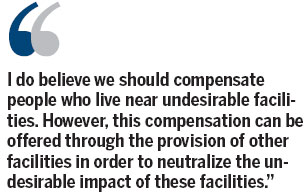
I do believe we should compensate people who live near undesirable facilities. However, this compensation can be offered through the provision of other facilities in order to neutralize the undesirable impact of these facilities. Also, the improved facilities in the neighborhood will most likely be used by people living nearby. This will make the compensation more direct. It is also a more equitable way to handle the whole compensation issue.
The author is dean of the School of Business at Hang Seng Management College.
(HK Edition 03/20/2014 page1)