Clearing up misunderstandings about constitutional reform
Updated: 2014-02-20 07:38
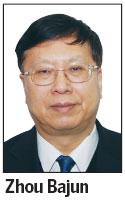
By Zhou Bajun(HK Edition)
|
|||||||


My friend Lau Nai-keung advocated in his opinion piece here on Feb 11 that a mechanism for the Chief Executive (CE) election by universal suffrage should allow Hong Kong people to have a veto power to ensure the CE is a competent leader. Although his concerns are most honorable, some of his arguments are wrong.
Lau said: "The CE election mechanism can be designed so the NC (Nominating Committee) serves as a 'goalkeeper' to ensure all candidates are acceptable to the central government, while the election process provides all eligible voters with an equal opportunity to 'veto' what the NC proposes." "With a bottom line in the nomination process and substantive appointment rights, the central government has already hedged its bets. Providing Hongkongers with a genuine veto power sends citizens a clear message that the 'dual accountability' towards both the central government and the people in Hong Kong is guaranteed institutionally".
Indeed, Article 43 of the Basic Law stipulates: "The Chief Executive of the Hong Kong Special Administrative Region shall be accountable to the Central People's Government and the Hong Kong Special Administrative Region in accordance with the provisions of this law", and this sounds like a "dual accountability". However, it isn't some sort of "equal dual accountability" because Article 12 of the Basic Law defines the constitutional relationship between the central government and the Hong Kong Special Administrative Region (HKSAR) this way: "The Hong Kong Special Administrative Region shall be a local administrative region of the People's Republic of China, which shall enjoy a high degree of autonomy and come directly under the central people's government."
I guess my friend temporally ignored this most important point. As a member of the HKSAR Basic Law Committee under the National People's Congress Standing Committee (NPCSC), Lau has written many articles correctly and accurately expounding the Basic Law.
The second misunderstanding is that the central government has guaranteed the HKSAR to achieve CE universal suffrage in 2017. Therefore, the opposition camp declares that Beijing should take full responsibility if the city fails to achieve universal suffrage in 2017.
Indeed, the decision of the NPCSC on Dec 29, 2007 clearly assigns that "the election of the fifth Chief Executive of the Hong Kong Special Administrative Region in the year 2017 may be implemented by the method of universal suffrage". However, everyone with a basic knowledge of English language understands the term "may be" means whether the "actual situation" close to the year of 2017 is right for implementing the CE's universal suffrage entirely depends on Hong Kong's political status in the future.
On March 24, 2013, Qiao Xiaoyang, chairman of the Law Committee under the National People's Congress, said the central government had insisted on "three points" in its handling of CE universal suffrage: First, the central government has consistently said the HKSAR may implement universal suffrage in 2017; second, the central government has insisted that the CE should "Love the Nation and Love Hong Kong", and any person who confronts the central government is unqualified to become the CE; and third, it has insisted that the scheme or mechanism for CE's universal suffrage must stick to the Basic Law and decisions by the NPCSC. These "three points" are bound together.
However, based on the wrong interpretation of the decision of the NPCSC in 2007, the opposition camp has said the central government, alone, should take full responsibility if no universal suffrage is introduced to Hong Kong in 2017. They pretend to occupy the moral high ground, recklessly and ruthlessly undertaking the "Occupy Central" campaign. This is to compel Beijing to accept so-called "genuine universal suffrage".
However, as I have reiterated in this column, constitutional reform in the SAR is a decisive political battle between the "Love the Nation, Love Hong Kong" camp and the opposition one. The "Love the Nation, Love Hong Kong" camp supported by the central authorities stands on the right side of history. Only the opposition's violation of the Basic Law and decisions of the NPCSC will frustrate the progress of constitutional reform and the implementation of universal suffrage. The central government has an obligation to insist on above-mentioned "three points" to uphold national sovereignty and territorial integrity in promoting the city's constitutional development through the implementation of universal suffrage.
The author is a veteran current affairs commentator.
(HK Edition 02/20/2014 page1)