Ending the crisis in maternity care
Updated: 2013-10-25 06:53
(HK Edition)
|
|||||||


Hospital Authority (HA) chairman Anthony Wu maintains that the crisis in the city's maternity wards created by non-resident mothers-to-be has been brought under control.
Public hospitals, Wu said, have admitted significantly fewer pregnant women from the mainland in recent years. "Public hospitals in Hong Kong accord first priority to the local people," Wu added.
He explained that from the HA's perspective there are two types of pregnant women. They are: Eligible Persons (EP) who are permanent Hong Kong residents and Ineligible Persons (NEP), who have established no legal right to reside here. Whether they come from the mainland or elsewhere, or whether their husbands are permanent residents of Hong Kong is not taken into account.
"In the past years when the demand for obstetric services by local women was not very high, we provided obstetrics packages to non-local women at a price," he said. "But as local demand grew, quotas for non-local women were cut and prices were raised. Also, we announced a zero quota for non-local women effective April 1, 2012 long before the CE halted the influx of mainland women."
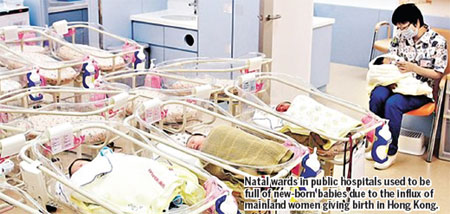
Since the 2001 ruling by the Court of Final Appeal on the petition of Chong Fung-yuen, children born in Hong Kong to mainland parents have enjoyed right of abode here. These babies have come to be called 'double-ineligible' because neither of their parents are permanent Hong Kong residents. The numbers of these babies have shot up quickly.
In 2001, there were only 620 "double ineligible" of babies. In 2006, there were 16,044 on the list, and in 2011, 35,736. The cumulative number exceeded 200,000 by the end of 2012. The majority of the non-resident babies were born in Hong Kong's private hospitals.
As these 'double-ineligible' babies return to avail their rights as premanent residents of Hong Kong, they are creating a strain on local resources. That includes healthcare, social welfare, education, housing and even on the availability of daily sundry supplies.
The circumstances prompted Chief Executive Leung Chun-ying, even before he was sworn in to take up his duties officially, to direct that private hospitals cease to admit pregnant mainlanders effective 2013. He added that babies born to mainland parents in Hong Kong from 2013 onward were not guaranteed right of abode in Hong Kong.
Wu, as HA chairman, expressed particular satisfaction with the rule changed that barred mainland women from being admitted for maternity care at private hospitals, in order to give proper care to local women. He noted that in previous years, obstetricians and nurses were being poached from the public sector by private hospitals, to satisfy the demands of pregnant women from the mainland. That Wu said, interfered with services for local women, created manpower shortages, imposed a heavy workload on staff at public hospitals, and caused low morale.
"Non-admission of expectant mothers from the mainland by private hospitals was a very good thing to the HA because it prompted the return of many doctors and nurses to public hospitals," he said enthusiastically.
Wu admitted the HA had not taken the right of abode issue into consideration when it began admitting expectant mothers from the mainland. That, he said, played a part in the large number of babies born to non-Hong Kong residents.
"The right of abode issue was something for the government to consider," he said.
(HK Edition 10/25/2013 page8)