Business schools' distinct new standards
Updated: 2013-06-01 08:03
By T.J. Wong(HK Edition)
|
|||||||


As one of the key financial centers in the world, the management education and development needs in Hong Kong can be very different than on the mainland. Similarly, managing a State-owned enterprise in Beijing differs significantly than managing a multinational corporation in Shanghai, or launching a start-up firm in Hangzhou. Yet often, despite these vast differences, many people think MBA programs and business schools are established to do the same things regardless of their location, strengths, and stakeholder needs. That is until now.
In April 2013, the governing membership of the Association to Advance Collegiate Schools of Business (AACSB) - an international accrediting body based in the United States - unanimously passed a set of new accreditation standards which will allow business schools in Hong Kong to better meet the needs of students and business by focusing more on what makes us distinct instead of similar.
Recently, at the AACSB's 2013 Asia Pacific Accreditation Conference hosted by the Chinese University of Hong Kong Business School in Hong Kong, the value and importance of these changes for business schools across the Asia-Pacific region was discussed.
At their core, the new standards recognize that business schools must be able and empowered to adapt as the pace of change in business accelerates. To do so, the new standards now provide business schools with the flexibility to create new and innovative programs which best fits an institution's strengths, as well as the capabilities to address local, national, or even regional needs. For students in Hong Kong, these changes will help individuals identify, and benefit from, the programs that best fit their needs and aspirations.
Additionally, the standards indicate that business schools must also make a greater impact in the communities they serve through their research and knowledge development. Now, AACSB will expect schools to not only show they do high-quality research, but demonstrate that this research has an impact on practice as well as theory - helping businesses in Hong Kong and beyond to become more innovative and competitive.
Similarly, new faculty standards now encourage business schools to develop a more diverse faculty base, in which practical business experience and academic knowledge are combined in deep ways. For example, a set of faculty members might focus on basic academic research, while others apply new ideas to real-life practice. Still others could bring extensive business experience to teaching and research projects. The key, according to AACSB, is that a faculty of different types working closely together will provide students with relevant, hands-on business knowledge, in tandem with strong academic knowledge.
There are also changes requiring business schools to put more emphasis on sustainability and corporate socially responsible leadership. As AACSB's President and CEO John Fernandes puts it: The world is expecting a lot from business and, accordingly from business schools. A better world must be built and business schools can lead the way. The environmental problems can be especially challenging across a large region such as Asia, where environmental and social issues extend across borders.
Throughout all this, it is important to note that higher education is not easy to change - particularly at the global level. But just as every organization has been challenged at times to reconsider how it can create value, so too did the leadership within business schools and AACSB. They realize that to develop the type of leaders that society needs for the future, management educators have to reassess their expectations of accreditation at the global level, as well as their own approaches within their social, economic, and cultural situations.
AACSB's Chief Accreditation Officer Robert Reid concluded that the new standards are designed to give business schools the flexibility to innovate to meet the needs of the employer and student markets while still holding institutions to the highest standards of quality. After all, the main responsibility of AACSB Accreditation is to ensure that business schools deliver the educational outcomes they promise to students.
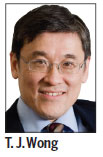
The author is dean of the Business School at the Chinese University of Hong Kong.
(HK Edition 06/01/2013 page6)